Inflatable Paddle Board Losing Air — Here’s the Fix
Inflatable paddle board troubleshooting has gotten complicated with all the conflicting advice flying around. As someone who’s been repairing iSUPs for about six years — my own boards, boards belonging to friends who’ve panic-texted me at 7 a.m. before a lake trip, and a handful I picked up secondhand specifically to diagnose and flip — I learned everything there is to know about why these boards go soft. The fix is almost always the same thing. Takes forty-five seconds, maybe. It’s the valve. Tighten the valve. That’s the whole article, except it’s not, because valve type matters, tightening technique matters, and if it actually isn’t the valve, you need a specific leak-finding method that most guides don’t bother mentioning.
We’re going through every scenario here, in order of likelihood. Don’t skip ahead.
Tighten the Valve First — This Fixes 95% of Slow Leaks
Probably should have opened with this section, honestly. Almost every “my board is losing air overnight” situation I’ve seen traced back to a valve that had vibrated itself slightly loose over time. Not dramatic. Just physics — pumping, deflating, rolling, unrolling, stuffing into a bag — the stem loosens incrementally. That’s what makes iSUP ownership endearing to us paddle board people. It’s always something small.
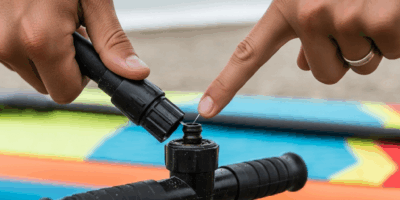
Here’s where people go wrong: they try to tighten the valve by hand, feel it go snug, and assume they’re done. They’re not. You need the valve wrench that came with your board. Hand-tight means nothing here.
The Halkey-Roberts H3 Valve — How It Actually Works
But what is the H3 valve? In essence, it’s a spring-loaded, push-pin valve with a two-position mechanism — one for inflation, one for deflation. But it’s much more than that. Most modern iSUPs use it: Red Paddle Co, iRocker, Atoll, Thurso Surf, and plenty of others. The center pin you push down to release air? That same pin creates the seal when the valve is properly seated. If the seat isn’t right, air finds a way out. Always.
To tighten it correctly, press the center pin down with one finger — hold it there — while you turn the outer valve body clockwise with the wrench. Quarter turn is usually enough. Sometimes half. You’ll feel it seat. Skip the press-down step and you’re just spinning the housing without seating the inner seal. Don’t make my mistake — I did it wrong four times before someone explained it clearly, which was embarrassing given that I was already reselling boards at the time.
Your board almost certainly shipped with a small yellow or black plastic valve wrench. Stubby, looks like a coin with notched edges. Check the bag that came with your pump. Lost it? Totally normal — replacement runs $3 to $5 on Amazon. Search “Halkey-Roberts valve wrench.” You’ll find it immediately.
Leaflet Valves — A Different Beast
Some older boards — certain early Starboard models, a few budget options — use a leaflet-style valve instead. Small rubber flap rather than a spring-pin setup. Tightening process is the same concept: valve wrench, clockwise. The failure mode is different, though. Leaflet valves fail more often from debris caught under the flap than from simple loosening. Keep that in mind when you get to the cleaning section below.
After tightening, inflate to rated PSI — usually 15 PSI for recreational boards, 20 PSI for performance boards like the Red Paddle Co Voyager 13’2″ — and let it sit for an hour. Pressure holds? Go paddle. Still dropping? Move on.
How to Find the Leak with Soapy Water and Glycerin
Inflate to full rated pressure before doing any leak detection. Half-inflated boards don’t push air through small punctures with enough force to produce visible bubbles. Full pressure only — no shortcuts here.
The Basic Soapy Water Method
Mix a few drops of dish soap — I use Dawn, brand doesn’t really matter — into about a cup of water in a spray bottle. Spray every inch of the board systematically: valve area first, then seams, then the top deck, then the rails, then the bottom. Watch for bubbles. A real leak produces a steady stream of small bubbles — not just foam from the spray itself, which looks different once you know what you’re looking for.
Seams are the second most common failure point after valves. Run your fingers along every seam while it’s wet — sometimes you feel air escaping before you see bubbles clearly. Pay extra attention to the tail and nose seams, which absorb the most stress during transport and inflation cycles.
The Glycerin Method — For Leaks Soapy Water Misses
This is the method most guides skip entirely, and it’s genuinely the better one for slow leaks. Some leaks are too small for soap bubbles to form visibly — the air escapes but the bubbles dissipate before you can pinpoint the location. Glycerin — same stuff you can buy at any pharmacy, about $4 to $6 for a small bottle — thickens the water enough that even micro-bubbles stay intact long enough to see.
Mix one part glycerin to about three parts water in a spray bottle. Apply it the same way you’d apply soapy water. The mixture creates a thin, gel-like film over the surface — air escaping through a slow leak pushes through that film as tiny, persistent bubbles that last several seconds rather than popping immediately. I found a pinhole in the seam of an older Bluefin Sprint 10’8″ using this method after thirty minutes of failing with soap and water alone. Small leak, real leak. Glycerin caught it in under two minutes.
Mark the leak location with masking tape before deflating. Don’t trust your memory — once the water dries, the leak spot looks identical to every other spot on the board. Ask me how I know.
Patching a Puncture the Right Way
Frustrated by a failed patch on my second iSUP, I spent a lot of time figuring out exactly where the process breaks down. The answer is almost always surface prep and cure time. People rush both — usually because they really want to go paddling, which is understandable and also the wrong call.
Here’s the full process:
- Deflate the board completely. Do not patch a board with any air pressure in it. The outward pressure fights the adhesive during curing and the patch will fail — usually at the worst possible moment, out on the water.
- Clean the damaged area thoroughly. Use isopropyl alcohol — 90% or higher, not the diluted 70% stuff — on a clean cloth. Wipe the area, let it dry fully. This removes sunscreen, salt, dirt, and oils that would prevent adhesion. Bone dry before you touch it again.
- Cut your patch to size. Tear-Aid Type B works well for PVC boards, as does the manufacturer-specific PVC patch material that shipped with your board. Cut the patch so it extends at least an inch beyond the puncture in every direction. Round the corners with scissors — square corners peel up eventually; rounded corners don’t.
- Rough up both surfaces lightly. A piece of 220-grit sandpaper applied with very light pressure on both the board surface and the patch material gives the adhesive better mechanical grip. Light pressure — you’re scuffing, not sanding.
- Apply PVC cement to both surfaces. Aquaseal works, as does the contact cement included in most repair kits. Thin, even layer on both the patch and the board. Let it sit until tacky — about 10 to 15 minutes depending on temperature and humidity. Do not skip this step. Press-and-stick patches without cement fail on PVC iSUPs. Every time.
- Press firmly for two minutes. Use a roller if you have one, or the back of a spoon. Work from the center outward to push out any air bubbles trapped underneath.
- Cure for 24 hours minimum. Put something heavy on the patch — a stack of books, a dumbbell — and leave it alone. I know you want to go paddle. 24 hours is the number. It’s not negotiable.
If the puncture is longer than about two inches, or if it’s on a seam, the repair gets more involved. For seam damage specifically, consider contacting the manufacturer — most reputable brands offer repair services or can ship seam-specific tape.
When the Valve Needs Cleaning or Replacing
You tightened the valve. No puncture found. Board still losing air. Time to look more carefully at the valve itself — because tightening and cleaning are two different things.
Debris in the Valve Seat
Sand, grit, and small debris get into valves — especially if you paddle in saltwater or on sandy beaches. A single grain of sand caught under the H3 valve’s center seal causes a slow, consistent leak that mimics a puncture almost perfectly.
With the board fully deflated, use a cotton swab dampened with fresh water to clean inside the valve opening. Get into the seat area around the pin. For leaflet valves, gently lift the flap with a thin tool and clean underneath it. After cleaning, apply a tiny amount of 303 Aerospace Protectant — not WD-40, which degrades rubber — to a fresh cotton swab and wipe the interior. The 303 keeps rubber seals supple and prevents cracking over time. A bottle runs about $12 to $16 and has roughly a hundred other uses on a board, so it’s worth having around anyway.
Replacing the Valve
Replacement Halkey-Roberts H3 valves run $10 to $15 — widely available on Amazon and from most iSUP accessory retailers. Unscrew the old valve counterclockwise with your valve wrench, clean the valve seat on the board, apply a thin bead of marine-grade sealant around the new valve’s base threads, and thread it in clockwise. Snug, not overtightened. Let the sealant cure per its instructions before inflating.
Genuinely, replacing a valve is a better investment than buying a new board. I’ve replaced valves on boards that went on to last another four seasons without issue. This new valve takes about ten minutes to install and eventually evolves into the reliable seal enthusiasts know and depend on today.
Normal Air Loss vs. Real Problems
This section saves a lot of unnecessary troubleshooting. Every iSUP loses pressure overnight. Every single one. This is not a defect — it’s thermodynamics, and apparently a lot of people don’t know about it.
Air inside a pressurized chamber contracts when temperature drops. Board goes from a warm afternoon paddle at 85°F to a 65°F garage overnight — the air inside contracts and your pressure drops. For a typical 10’6″ to 11’6″ recreational board, that’s 1 to 2 PSI of loss just from a 20-degree temperature swing. Normal. Expected. Not a failing board.
The number that actually matters: if your board loses more than 3 PSI over a 24-hour period at a stable temperature — meaning you’ve accounted for temperature changes — you have a real leak. Less than that, in a stable environment, is just the board doing what boards do.
Here’s a practical test. Inflate inside your house, where temperature is stable. Check pressure with a quality digital gauge — the gauges built into most hand pumps are off by 2 to 3 PSI, which makes them nearly useless for this kind of testing. I use a Lezyne Digital Gauge that cost about $35; it’s accurate and I trust the readings. Note the pressure and the time. Check again 24 hours later, board still inside at the same temperature. More than 3 PSI lost? Investigate. 1 to 2 PSI? Inflate and go have a good paddle.
First, you should know about new board behavior — at least if your board is fresh out of the box. New boards often lose a little extra air in the first few inflations as seams fully seat and the PVC material stretches to its final shape. Losing 2 to 3 PSI on the first overnight is probably not cause for alarm. Inflate it a few more times and recheck. Most of the time the issue resolves itself within three to five inflation cycles as everything settles in.
A quality digital gauge might be the best option, as proper iSUP diagnosis requires accurate baseline readings. That is because the hand pump gauges most people rely on introduce enough error to make the whole test meaningless — you think you’re measuring a leak when you’re actually measuring gauge variance.
Inflatable paddle board issues almost always turn out to be valve issues, and valve issues are almost always one valve wrench turn away from solved. Start there, work through these steps in order, and you’ll almost certainly be back on the water without spending a dollar on a new board.

Stay in the loop
Get the latest paddleboard spots updates delivered to your inbox.