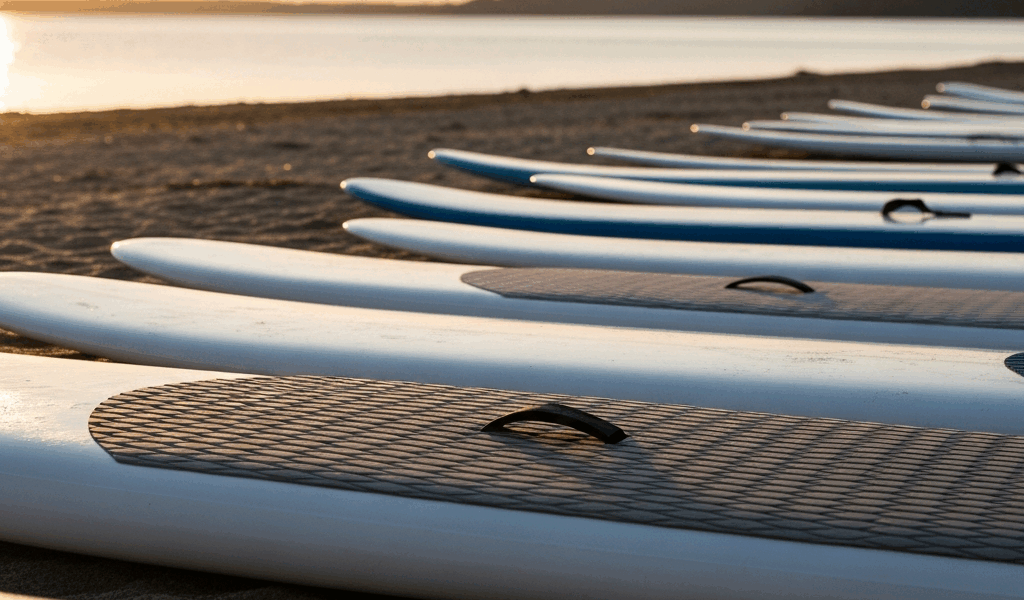
Why Width Matters More Than Length
Paddle board sizing has gotten complicated with all the Instagram content and gear-review noise flying around. As someone who spent an entire first summer eating water off a 28-inch board, I learned everything there is to know about what actually keeps you upright. Today, I will share it all with you.
That first summer — honestly, it was humiliating. I fell off approximately 400 times. Not rounding up. My palms were shredded raw, my ego was somewhere at the bottom of the lake, and my friends quietly stopped extending invitations. All because nobody told me the one thing that actually matters before you buy.
Width determines stability. That’s it. That’s the whole secret.
But what is width, really, in the context of board selection? In essence, it’s the measurement across the board’s widest point — usually right around center. But it’s much more than that. It’s the difference between a board that forgives you and one that punishes you every third stroke.
Most beginners fixate on length. They want those sleek 11- or 12-foot boards they see in everyone’s feed. Meanwhile, width — the actual stability variable — gets ignored completely. A wider board gives you more surface area. More surface area keeps the board flatter in the water. Flatter means harder to tip. Harder to tip means you stay on it. Simple.
Standard widths run from 28 inches on the narrow end — racing boards, experienced paddlers only, not you yet — up to 36 inches for heavier riders or anyone who genuinely prioritizes stability over speed. The sweet spot for most adults lands somewhere between 32 and 34 inches. Wide enough to forgive your wobbles. Not so wide that stepping onto it feels like standing on a parking space.
After my disastrous narrow-board summer, I switched to a 32-inch all-around. Same lake. Same paddle. Same thoroughly average athletic ability. The difference was absurd — I went from swimming every few minutes to actually paddling. A four-inch adjustment changed everything. Don’t make my mistake.
Thirty-two inches should be your absolute floor as an adult, full stop. Below that, you’re fighting physics before you’ve even learned technique. Above 34, you gain stability but sacrifice some turning responsiveness. The range exists for a reason.
Width by Body Weight
Your body weight is the most reliable starting point for figuring out what width you actually need. Heavier riders displace more water, which pushes the board lower if it’s too narrow. Lower in the water means unstable. Unstable means swimming. So, without further ado, let’s dive in — by weight bracket.
Under 150 Pounds
If you’re under 150 pounds, 30 to 31 inches is your range. These aren’t race boards — they still offer genuine stability — but they give you better maneuverability and a more responsive feel. Turning isn’t a project. Paddling feels quick. The board tracks without feeling like you’re steering a bathtub.
Lighter riders sometimes eyeball 28-inch boards thinking their lower weight means they can handle the narrow profile as beginners. Technically, sure, you might stay on it. But “technically staying on” and “actually having fun” are two completely different experiences. Thirty inches is your floor. Respect it.
150 to 200 Pounds
This is where most adults land, and it’s exactly where the 32-to-34-inch recommendation lives. That’s what makes this range so well-served — brands like iRocker, Bluefin, and Naish build specifically toward this market. Walk into any major paddle sports retailer and roughly 70% of the floor models will be aimed right at you.
A 32-inch board at this weight sits properly in the water. You’re not fighting it. A 34-inch board trades a bit of quick turning for even more planted stability — ideal if you’re nervous on the water, or if you’re planning to fish from the board with gear piled up around you. Both widths work well here. Personal preference makes the final call.
Over 200 Pounds
Once you’re above 200 pounds, 34 to 36 inches isn’t a conservative suggestion — it’s physics. Heavier riders on narrow boards sink the edges closer to the waterline, and edge proximity means the board tips with very little provocation. Tipping equals falling. Falling constantly ruins the sport before you’ve had a chance to like it.
I’d actually push toward 35 inches as a starting point rather than 34 in this weight range. The small speed penalty is genuinely worth the stability gain. Progression happens when you stay on the board — not when you’re repeatedly climbing back onto it.
Riders at 300-plus pounds should look at specialized touring boards running 36 inches or wider. They exist. Tower and Atoll both make options in this range. These aren’t racing boards, obviously, but they work beautifully for heavier paddlers who want actual time on the water rather than in it. That’s what makes this category endearing to us bigger paddlers — someone finally built boards with us in mind.
Width by Skill Level
Weight gives you your baseline. Skill level adjusts it. Probably should have opened with this section, honestly — most of the paddle board frustration I’ve watched up close traces directly back to skill-level mismatches, not weight miscalculations.
Beginner Level
Beginners should add roughly 2 inches on top of whatever the weight-based recommendation suggests. If you’re 160 pounds and the weight chart points to 32 inches, look for 34 inches instead. That extra width is a stability cushion while you’re still figuring out balance and paddle technique simultaneously.
There’s no meaningful speed penalty at the beginner stage anyway — your limiting factor is technique, not board responsiveness. Extra width builds confidence faster, and faster confidence means you’re actually progressing toward intermediate skills rather than spending every session just surviving. Get the wider board. Spend a season on it. Then reassess.
Intermediate Level
Once you’ve logged 20-plus days on the water and can paddle a reasonably straight line without constant overcorrecting, drop the beginner buffer. A 160-pound intermediate paddler rides that 32-inch board without a second thought. Your balance has developed. Your paddle stroke is solid enough to actually use the board’s responsiveness rather than fight it.
This is the level where board dimensions start feeling like a genuine choice rather than a survival strategy. Use your weight-based recommendation straight — no padding needed.
Advanced and Racing
Advanced paddlers and racers go narrower on purpose. A 200-pound experienced paddler might happily ride a 31-inch board — sometimes narrower. Speed matters more than maximum stability at this level. These riders have hundreds of hours on the water, excellent technique, and they’ve chosen narrow intentionally after understanding exactly what they’re trading away.
This applies to a small percentage of paddlers. If you’re reading a width guide, it probably doesn’t apply to you yet — and that’s completely fine. Everyone who paddles well started somewhere wider.
Common Mistakes When Choosing Width
Choosing poorly happens constantly. I’ve watched friends repeat these exact errors, sometimes twice.
Buying a Touring Board as Your First Board
Frustrated by feeling limited on a rental board, many beginners walk into a shop and go straight for the touring models — the ones that look fast and serious. These boards typically run 30 to 31 inches because they’re engineered for efficient distance paddling, not beginner forgiveness.
A beginner on a 30-inch touring board is fighting the board constantly. The board feels tippy. Progress stalls around week two. Interest fades shortly after. Your first board should prioritize stability above everything else — 32 to 34 inches, all-around or beginner category. Spend a real season on it. Upgrade to the touring board later, once you’ve earned it through actual time on the water. Don’t start there.
Prioritizing Brand Over Actual Dimensions
A recognizable brand name doesn’t make a board the right width for your body. I’ve watched people spend $1,100 on premium boards that were genuinely wrong for their weight — purely because the brand felt trustworthy. The spec sheet doesn’t care about brand reputation. The water doesn’t either.
A $400 board at the correct width beats a $1,200 board at the wrong width every single time. Check the actual dimensions. A 32-inch board that says “Naish” on the side and a 32-inch board that says “iRocker” behave similarly at the width level. The inches matter infinitely more than the logo.
Not Accounting for Gear Weight
Planning to fish from your board? Carrying a cooler, a rod, a tackle box, maybe a dry bag? That’s easily 25 to 40 additional pounds sitting on the board with you. The board doesn’t know those pounds belong to gear rather than your body — it just knows the total displacement.
A 190-pound angler with 35 pounds of fishing gear is effectively a 225-pound paddler from the board’s perspective. Size accordingly. If you consistently paddle with 30-plus pounds of equipment, move up a width bracket. Factor in your actual on-water weight — body plus typical gear load — not just the number on your bathroom scale.
Buying Online Without Double-Checking Specs
I’m apparently detail-obsessed enough that I cross-reference manufacturer specs before purchasing anything, and that habit has saved me twice. Once, a retail listing said 32 inches, but the manufacturer’s actual spec page — buried three clicks deep — listed 31.5 inches. Half an inch sounds trivial. It felt noticeably narrower in actual use. I was annoyed for an entire season.
Check the official manufacturer specs before committing. If you’re buying through a major retailer, verify their listed dimensions match the brand’s own documentation. Product listings have errors. Manufacturer spec sheets are authoritative. Don’t trust the listing alone — at least if you want to avoid the experience of receiving a board that’s subtly wrong in a way you can’t easily return.
Width is the single most important stability decision in the entire board-buying process. Get it right. The brand, the color, the included accessories, the fancy carbon fiber paddle — all of it matters less than those inches at the board’s widest point. A properly matched width transforms paddling from a frustrating, wet, ego-bruising ordeal into something you’ll actually want to do every weekend. That transformation is completely worth the research.
If a correctly sized board still feels unstable, use our ten-step wobbly paddle-board diagnostic to check conditions, pressure, load, fins and stance.

Stay in the loop
Get the latest paddleboard spots updates delivered to your inbox.