Why Your Paddle Board Feels So Unstable
Paddle boarding has gotten complicated with all the conflicting advice flying around. “Bend your knees.” “Relax your core.” “Buy a better board.” None of it actually tells you why you’re wobbling — or what to do about it in any specific, useful way.
As someone who spent an entire first summer convinced I was just bad at this, I learned everything there is to know about iSUP stability problems. Today, I will share it all with you.
Here’s the short version: five things cause almost every stability problem beginners run into. Underinflation. Wrong fin setup. Bad stance. A board that’s too narrow for your skill level. Water conditions you’re not ready for yet. That’s it. Work through those five in order and you’ll find your culprit — probably faster than you’d expect.
So, without further ado, let’s dive in.
Check Your Inflation Level First
This is the one everyone gets wrong. Seriously, everyone.
I’m apparently terrible at gauging air pressure by feel, and my cheap hand pump works for me while my confidence in “firm enough” never actually translates to real PSI. My first iSUP came with that same hand pump most boards include. Two minutes of pumping and the deck felt solid. I figured that meant full. It did not mean full. I wobbled through three months of weekend sessions before a guy at the lake grabbed my board, bounced on it once, and said “you’re running this thing at maybe half pressure.”
Don’t make my mistake.
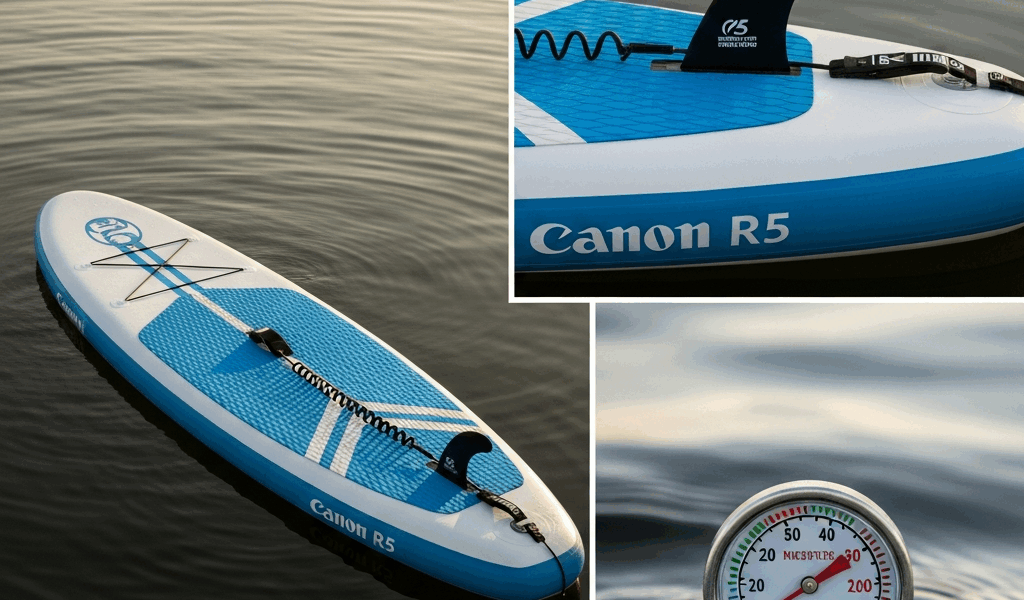
Inflatable SUPs should sit between 12 and 15 PSI — most brands print the target range right on the board near the valve. A digital pressure gauge runs about $12 on Amazon and removes all the guesswork. No gauge yet? Use the squeeze test. Press your thumb firmly into the rail near the edge. Sinking in more than a quarter-inch means you need more air. A properly inflated board requires real effort to dent even slightly.
An underinflated board flexes. Every weight shift makes the deck dip a little. That constant micro-movement creates wobble that no amount of knee-bending fixes — your nervous system feels the instability, you tense up, and suddenly you’re convinced you’re terrible at paddle boarding when really your board is just soft as a pool float underneath you.
Pump it to spec first. Before anything else. Before you adjust your stance, before you blame the board, before you list it on Facebook Marketplace. This single fix solves the problem for more beginners than every technique tip combined.
Your Stance Is Probably Wrong — Here Is How to Fix It
Once your board is actually inflated, stance matters.
Feet shoulder-width apart. Not hip-width, not wider — shoulder-width. Centered between both rails, like you’re straddling an invisible line running straight down the middle of the deck. Toes forward. Knees slightly bent. That last part is non-negotiable.
Locked knees are the fastest path to falling. Straight legs remove your body’s shock absorbers entirely — one small wake hits and there’s nowhere for the energy to go except sideways. Bent knees let your legs act like springs. Small movements get absorbed. You stay on the board.
Here’s a less obvious fix: keep your paddle blade in the water more than feels natural. Most beginners lift the blade completely between strokes to reset for the next one. That brief moment — blade in the air, no contact with water — eliminates your third point of stability. A paddle blade trailing in the water, even passively, gives you three contact points instead of two. Sounds minor. Changes everything, honestly.
Hand position matters too. Shoulder-width grip on the paddle shaft. Too narrow and your paddle becomes a tightrope walker’s balance pole. Too wide and you lose leverage on every stroke. Shoulder-width works consistently across almost every body type.
Fin Setup and Board Width Can Make or Break Stability
Probably should have opened with this section, honestly.
But what is fin configuration, really? In essence, it’s the difference between a board that tracks straight and a board that grips the water laterally. But it’s much more than that — it determines how the whole board responds when you shift your weight unexpectedly.
A single large center fin is great for tracking straight lines and terrible for lateral stability. If you feel like you’re constantly sliding sideways or tipping rail-to-rail, a thruster setup — center fin plus two smaller side fins — gives you dramatically more grip and responsiveness. Trade-off is slightly less straight tracking and a bit more paddle work to stay on course. For beginners focused on just staying upright, that trade-off is worth it.
Board width is the other variable nobody talks about directly enough. Boards under 30 inches wide are performance tools — fast, responsive, designed for experienced paddlers who already have their balance dialed in. Most beginners need to be on something 31 to 34 inches wide. A 32-inch board feels like a completely different piece of equipment compared to a 28-inch board. Those four inches of extra platform mean more forgiveness for imperfect weight distribution, less wobble when a wake catches you off guard.
If your board is 29 inches or narrower and you’re newer to this, you’ve chosen the wrong tool for the job. That’s not a judgment — it’s physics. Width is stability. You cannot technique your way around a board that’s too narrow for your current skill level. That’s what makes board width so endearing to us beginners — once you get on the right one, everything clicks.
When the Water Is the Problem, Not You
Frustrated by what felt like my own incompetence, I once paddled into open chop on a breezy Saturday morning using a 31-inch board at full PSI with a solid thruster setup — and still felt completely out of control.
The water was the problem. Not me. Not the board.
Calm water hides technique problems. Rough water exposes every single one instantly. Boat wakes, wind chop, river current — these are external stability killers that even experienced paddlers feel. The difference between a beginner and someone with two seasons under their belt isn’t that experienced paddlers stop wobbling in rough conditions. It’s that they’re expecting it and they’ve already adjusted.
In chop, adjust three things. Lower your stance — drop your center of gravity closer to the deck. Widen your feet slightly beyond shoulder-width. Shorten your paddle strokes significantly. Long sweeping strokes in rough water throw off your balance constantly. Short controlled strokes keep everything tighter and more manageable.
Start on flat protected water. Lakes beat rivers. Bays beat ocean breaks. Build your confidence and muscle memory where conditions are predictable. Rough water becomes optional advanced practice once you’re solid — not your default training environment from day one.
Your Stability Diagnostic Checklist
Work through these in order:
- Inflation: Is your board sitting at 12-15 PSI? Use a gauge — about $12 on Amazon — or the squeeze test on the rail.
- Stance: Feet shoulder-width apart, centered on the board, knees bent, paddle blade staying in the water between strokes?
- Board width: At least 31 inches? Anything narrower requires intermediate balance skills you’re still building.
- Fins: Running a thruster setup for lateral stability, or a single center fin that prioritizes tracking over grip?
- Conditions: Flat protected water or open chop? Your environment matters more than most beginners realize.
Most instability gets solved at step one. That was true for me, and it’s true for nearly every newer paddler I’ve talked through this with. Nail the inflation, move to stance, work down the list methodically. You’ll find the culprit. Fix it. Then stop wobbling — and start actually enjoying the thing you bought.

Stay in the loop
Get the latest paddleboard spots updates delivered to your inbox.