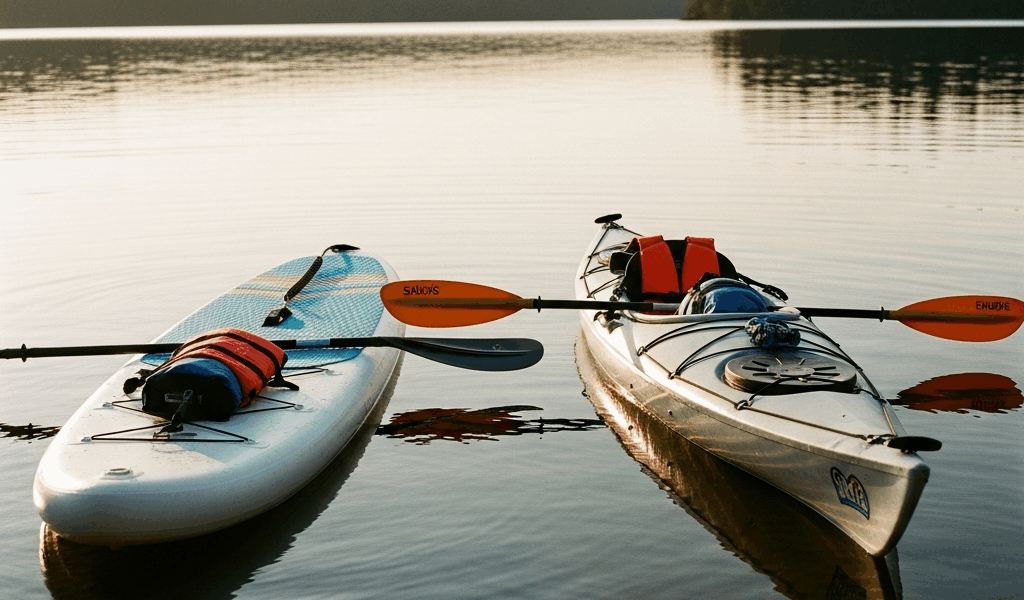
Paddle Board vs Kayak — Which Is Better for Beginners
The paddle board vs kayak debate has gotten complicated with all the sponsored content, gear-brand listicles, and contradictory forum advice flying around. As someone who has rented, borrowed, bought, and beaten up both types of gear across a half-dozen states, I learned everything there is to know about what actually separates these two experiences for someone just starting out. Today, I will share it all with you.
Quick disclaimer before we go further: most articles on this topic are quietly funded by SUP brands with a financial stake in your decision. This one isn’t. I bought a beat-up sit-on-top kayak — Perception Pescador 10, $420 used off Craigslist — before I ever touched a paddleboard. First time on a SUP, a friend’s inflatable iROCKER, I spent twenty humbling minutes looking like a newborn deer on a frozen pond. Didn’t fall in. Barely. That gap between those two experiences is essentially what this whole article is about. So, without further ado, let’s dive in.
Stability — Kayak Wins on Day One
No sugarcoating this one. A kayak is more stable on your first session. Sitting down drops your center of gravity several inches below where it sits when you’re standing upright on a board — and physics doesn’t care about your optimism. In a kayak, you feel planted. You can dig through your dry bag, take a photo, eat a granola bar. The little voice that says “you’re about to go in” stays quiet.
A wide sit-on-top model — think the Lifetime Tamarack Angler 100 or the Sun Dolphin Aruba 10 — has a hull that almost anyone can climb onto and immediately paddle without a single lesson. That instant confidence is real. It matters enormously if you’re bringing kids or older adults out for the first time.
Standing on a paddleboard is a different introduction entirely. Even a wide, stable inflatable — something in the 32-to-34-inch range like the iROCKER Cruiser Ultra or the Bluefin Cruise 10’8″ — feels tippy at first. Your ankles make constant micro-adjustments. Your core fires whether you asked it to or not. Most new paddlers grip the paddle too hard, which locks up their upper body, which ironically makes balance worse. I did exactly this. For about forty minutes.
That wobble phase doesn’t last forever, though. Almost every beginner finds their footing within one or two sessions — not hours, sessions. Something neurological happens where your body stops fighting the board and starts reading it. Wide modern inflatables are genuinely stable once that clicks. But on day one, in that first hour? The kayak wins. Not by a little. By a lot.
Kneeling as a Bridge
One underrated move for new SUP paddlers — start on your knees. Most boards handle kneeling beautifully. Your center of gravity drops immediately, and you can dial in your paddle technique before committing to standing. I skipped this advice my first time out and paid for it in exhausting, wobbly minutes I didn’t need to earn. Don’t make my mistake. Ten or fifteen minutes of kneeling is genuinely enough to reset your relationship with the board before you stand up.
Fitness and Full Body Workout
Probably should have opened with this section, honestly, because fitness is the primary reason a lot of people are comparing these two activities in the first place.
Kayaking is genuinely good exercise. The pulling motion hammers your lats, biceps, shoulders, and rotator cuff. Paddle for an hour at moderate pace and you’ll feel your upper back the next morning. It’s low-impact, joint-friendly, and accessible to people with lower body limitations — a real advantage worth naming plainly.
SUP is a different category of physical challenge. Standing upright and paddling engages your core constantly — not in a burning, crunching way but in a stabilizing, postural way that builds endurance over time. Your legs are working. Your glutes are working. Your arms and shoulders are obviously working. An hour on a paddleboard burns roughly 300 to 400 calories depending on pace and conditions, compared to approximately 200 to 350 for recreational kayaking at similar intensity. The numbers aren’t dramatically different — but the muscle distribution across your body absolutely is.
SUP Yoga and Cross-Training
Here’s where the paddleboard starts earning its versatility reputation. SUP yoga is a legitimate practice — not a novelty. Performing yoga poses on a gently unstable floating surface dramatically increases the proprioceptive demand on your stabilizer muscles. Poses that feel routine on a mat become genuinely challenging on a board, in a productive way that carries over to everything else you do physically.
Beyond yoga, a quality inflatable SUP works for fitness paddling, flat-water HIIT sessions, and even beginner-friendly whitewater with the right board. A kayak, pulled toward one purpose, is harder to repurpose. The functional range of a paddleboard is simply wider — which means one upfront investment covers more ground over the years.
Seated SUP Option
Worth mentioning here — most quality inflatables now ship with D-rings and compatibility for kayak seat attachments. The iROCKER All Around 11′, for example, includes a kayak conversion kit option. You can paddle it as a SUP for the workout, then clip in a seat when your legs are tired or conditions get choppy. That hybrid use case matters a lot when you’re trying to pick just one thing to buy.
Transport, Storage, and Cost
This is where inflatable paddleboards make their most compelling case — and it has nothing to do with fitness or fun. It’s purely logistical. Logistics matter enormously in whether gear actually gets used or slowly dies in a garage.
A hardshell kayak — even a short recreational model — runs 10 feet long and 40 to 50 pounds. Getting it to the water requires a truck bed, a roof rack, or a trailer. A J-bar roof rack setup for a standard sedan runs $150 to $300 installed. Add straps, bow and stern tie-down lines, and the patience to load and unload the thing every single trip. Storage at home means a garage, a shed, or a dedicated outdoor rack. For apartment dwellers or anyone without significant storage space, a hardshell kayak is a genuine logistical problem before it’s anything else.
An inflatable SUP — the Bluefin Cruise Carbon 10’8″ or the Red Paddle Co Ride 10’6″, for instance — rolls down into a backpack-sized bag that fits in a closet, a car trunk, or overhead on some airlines. Setup takes 8 to 12 minutes with an included hand pump. Three minutes with an electric pump. You carry it to the water like a large piece of luggage. That’s the whole system.
Price Comparison
Entry-level recreational kayaks run $350 to $700 for a decent sit-on-top. Add the roof rack and you’re at $500 to $1,000 before you’ve bought a paddle. Entry-level inflatable SUPs start around $400 for budget boards — the ISLE Explorer, the Roc Explorer — and climb to $900 to $1,200 for quality mid-range options from iROCKER, Red Paddle Co, or Bluefin. Those prices typically include the paddle, pump, and carry bag. On an all-in basis, the cost gap is smaller than most people expect — but the SUP requires zero accessories to get it to the water.
Hardshell kayaks are more durable over 20-year timelines and hold resale value well. Quality inflatables from reputable brands last 5 to 10 years with basic care. Budget inflatables from Amazon no-name brands — the $250 boards — often don’t survive two seasons. I’m apparently someone who learned this the hard way, and avoiding cheap boards works for me while ignoring that advice never does. Don’t buy the $250 board. Just don’t.
Fishing — One Area Where Kayak Wins Clearly
If fishing is part of why you want to be on the water, the kayak wins this category without argument. Fishing kayaks like the Old Town Topwater 106 or the Native Watercraft Titan 10.5 are purpose-built — rod holders, tackle storage, anchor trolleys, stable seated casting platforms built right in. Standing on a SUP while managing a rod, line, and a landing net is technically possible. Some experienced anglers do it well. But it is not a beginner experience. It’s advanced. Start in a kayak if fishing is your primary goal.
The Verdict — Match Your Priority
But what is the right answer here? In essence, it’s whatever solves your specific problem. But it’s much more than that — because the wrong framework is asking which is objectively better instead of which is better for what you’re actually trying to do.
Frustrated by cramped apartment storage and carrying a roof rack everywhere, most paddlers eventually migrate toward an inflatable SUP using a quality board from a known brand. The iROCKER Cruiser Ultra at around $799 and the Red Paddle Co Ride 10’6″ at around $1,049 are both genuinely excellent starting points. Plan to feel wobbly for a session or two. Accept that the learning curve is the price of entry for a tool that can do more things over its lifetime.
First, you should go with a kayak — at least if you want immediate comfort on the water, plan to fish regularly, or are paddling with younger kids who need rock-solid stability. A sit-on-top in the $400 to $600 range from Perception, Lifetime, or Sun Dolphin gets you comfortable from session one. Add a basic roof rack and you’re set. That’s the whole setup.
A quality inflatable SUP with a kayak seat attachment might be the best option, as beginners who want both activities require genuine versatility in one package. That is because a board like the iROCKER All Around 11′ — around $799, includes D-rings for seat attachment — handles both roles credibly. It’s 85% of a kayak and 85% of a SUP in one bag that fits in your closet. Not perfect in either mode. But remarkably capable across both.
That’s what makes the hybrid inflatable option endearing to us gear-conscious beginners who don’t want to buy two large items and store them somewhere we don’t have space.
The honest truth most comparison articles avoid saying plainly: kayaking is more forgiving on day one, and paddleboarding rewards whoever has patience to push past that first awkward session. Both will get you outside, on the water, away from a screen. Neither choice is wrong. The wrong choice is overcomplicating the decision until the season ends and you’ve bought nothing at all.
Pick the option that solves your actual logistical problem, matches your primary motivation, and fits your storage reality. Then go use it before summer disappears.

Stay in the loop
Get the latest paddleboard spots updates delivered to your inbox.