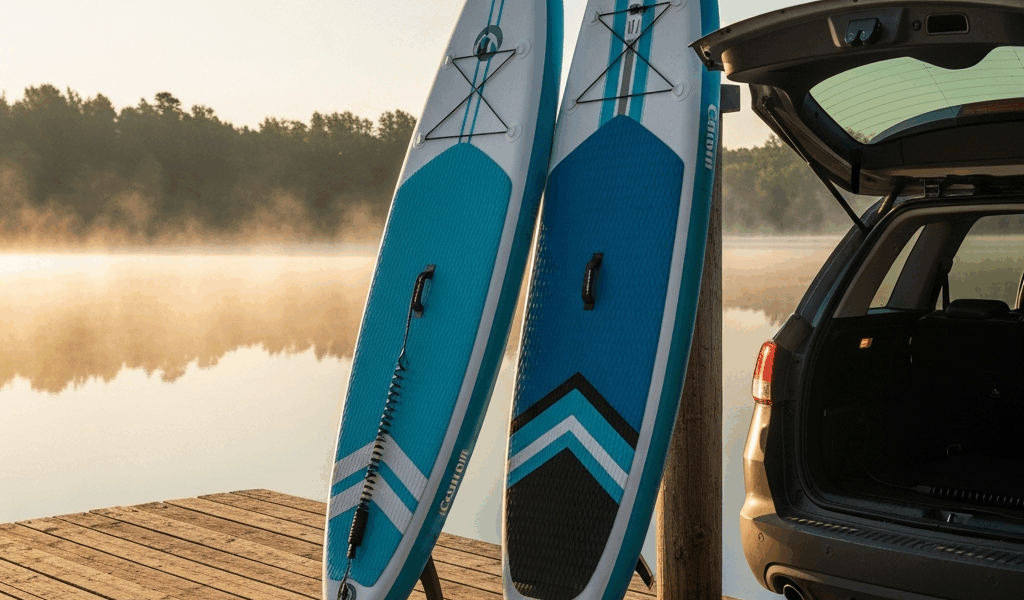
Hard vs Inflatable Paddle Board — Which One Wins
Why This Comparison Actually Matters
Hard vs inflatable paddle board has gotten complicated with all the sponsored reviews and wishy-washy “it depends” noise flying around. As someone who has owned a 10’6″ Bote HD Aero inflatable and a 9’6″ Surftech fiberglass hardboard simultaneously, I learned everything there is to know about this debate through actual use — flatwater lakes in Minnesota, choppy ocean inlets near Fort Lauderdale, and yes, dragging both types through airport terminals at 6 a.m. Today, I will share it all with you.
This article includes affiliate links. We may earn a commission at no extra cost to you.
But what is the real difference between these two board types? In essence, it comes down to construction. Hard boards — rigid, fiberglass or carbon fiber over foam — hit the water ready to go. Inflatables are drop-stitch PVC that fold into a backpack and need pumping up first. But it’s much more than that. Every real-world difference between these boards — performance, storage, durability, travel — flows from that one mechanical fact.
So, without further ado, let’s dive in. Each section below targets a specific real-world situation. At the end, you get a direct recommendation based on your paddler profile. Not “it depends.” An actual answer.
Performance on the Water — Does It Feel Different
Yes. Absolutely yes — and pretending otherwise is how you end up with the wrong board for two seasons before admitting it.
Hard boards glide. That’s the single best word for it. Take a stroke on a Jimmy Styks Oahu or a Tower Adventurer hardboard and the board lunges forward and keeps moving. Tracking is crisp. The nose holds a line without constant correction. In surf, weight shifts translate immediately. You feel genuinely connected to the water in a way that’s difficult to articulate until you’ve actually experienced it.
Modern inflatables have closed the gap considerably — I’ll give them that. A quality 6-inch-thick board like the iRocker Cruiser or the Red Paddle Co Ride 10’8″ is stiff enough that most casual paddlers won’t notice much difference on flat water. The flex underfoot has mostly been engineered out of premium boards. But “mostly” is doing a lot of heavy lifting in that sentence.
Push an inflatable through a fast surf turn and you’ll feel the washout immediately. Take it into a race and you’re losing time on every single stroke recovery. At intermediate-to-advanced level, hard boards win on performance. The physics of a rigid hull versus pressurized PVC are simply not negotiable.
For beginners and casual Saturday-morning paddlers? Honestly, the gap is small enough that it doesn’t really matter. You’re not racing. You’re not charging waves. You’re enjoying a lake.
Storage, Travel, and Everyday Convenience
Inflatables win this category. Not close. Not debatable.
Probably should have opened with this section, honestly — because for most buyers, storage is the deciding factor before performance even enters the conversation.
A 10-foot hard board needs a roof rack, a garage, or dedicated storage space. That’s a real commitment. I learned this the hard way after moving into a Minneapolis apartment in 2021 and spending three months with my Surftech propped against the living room wall like aggressive modern art. My roommate was not thrilled. We don’t talk about that period.
An inflatable rolls down into a bag roughly the size of a large duffel. The Bote HD Aero I mentioned packs into a closet, a car trunk, or — and this part is genuinely useful — a checked airline bag. Red Paddle Co and Bluefin both make boards designed specifically to meet standard airline luggage dimensions. I flew with an inflatable SUP to Costa Rica in 2022. That is not something you do with a hardboard. Ever.
The trade-off is pump time — and don’t let anyone gloss over this. Getting an inflatable to the recommended 12–15 PSI with a manual hand pump takes 10 to 15 minutes of real physical effort. It’s not terrible, but it’s also not nothing, especially standing in a parking lot on a humid Florida morning before you’ve even touched the water. Electric pumps like the Bravo BTP12 solve most of that problem for around $60–$80. That’s an additional purchase to budget for, though.
- Apartment or small home with no storage — inflatable wins by default
- Flying to a paddle destination — inflatable is the only practical choice
- Road trip without a roof rack — inflatable fits in the back seat
- Tired of wrestling a 25-pound board off the car every single session — inflatable wins
If you already have a garage and a roof rack, this category matters less. But a lot of people don’t — and that’s worth being honest about.
Durability and Longevity — Which One Lasts Longer
The “fragile inflatable” myth needs to die. Military-grade PVC drop-stitch construction — thousands of interlocking threads holding two PVC layers together under high pressure — bounces off rocks, survives bumpy car trunks, and handles being dropped on concrete without complaint. I’ve watched paddlers toss inflatables off boat docks without a second thought. They’re fine.
Hard boards, meanwhile, ding. A rock strike on fiberglass can crack the outer shell and allow water into the foam core — that causes delamination, which is exactly as bad as it sounds. The top layer bubbles and separates. Once it starts, it’s genuinely difficult to stop. Proper repair means epoxy filler, careful sanding, and patience most people don’t have after a long paddle day. Most people put it off. The problem gets worse. Don’t make my mistake.
That said, inflatables have their own maintenance requirements. UV exposure degrades PVC over time — I’m apparently bad at remembering this, and leaving boards on a roof rack in direct Florida sun for hours every weekend shortened my first inflatable’s life noticeably. Store it partially deflated, out of direct sunlight, away from extreme heat. The valve is the most common failure point and deserves a periodic check. A basic repair kit with PVC patches handles most punctures, which are rare but do happen.
Realistically, a well-maintained inflatable from a reputable brand lasts 5–10 years. A well-maintained hard board lasts longer — 10 to 15 years or more. But “well-maintained” is doing heavy lifting there. Most hard boards I’ve seen after five years of regular use carry a collection of ding repairs and at least one delamination patch somewhere near the tail.
Neither type is fragile. Both need basic care. Hard boards punish neglect more severely — full stop.
Which Board Type Should You Actually Buy
Here are direct calls based on paddler profile. No hedging.
Beginner with Limited Storage
Buy an inflatable. Something like the iRocker All-Around 10′ ($699–$799) or the Bluefin Cruise 10’8″ gives you a stable, forgiving platform that stores in a closet. The performance gap at beginner level is negligible. The convenience gap is enormous. That’s what makes inflatables so endearing to us apartment-dwelling paddlers.
Intermediate Surfer or Racer
Buy a hard board — at least if you’re actually chasing waves or competing. The responsiveness of a rigid hull matters at this level. Look at the Boardworks Solr or a used Jimmy Styks model if budget is a concern. The performance return is real and you’ll feel it on every session.
Traveler or Multi-Sport Adventurer
Inflatable, without question. Flying with your board, packing it into a kayak camping setup, or throwing it in the back of a rental car changes the entire calculus here. Red Paddle Co’s MSL construction and Bote’s AeroULTRA line are worth the premium if you travel more than a few times a year.
Casual Lake Paddler with a Garage
Either genuinely works. But if you have the storage and you’re paddling the same lake every weekend, lean toward a hard board. You’ll notice the glide on every session. Stepping onto a rigid board after a year on an inflatable feels like an upgrade you didn’t know you needed — and then you wonder why you waited.
Frustrated by comparison articles that never commit to an answer, most paddlers end up buying whatever was on sale and second-guessing it for two full seasons. Don’t do that. Your situation just told you which board wins. Trust it, make the call, and get on the water.

Stay in the loop
Get the latest paddleboard spots updates delivered to your inbox.