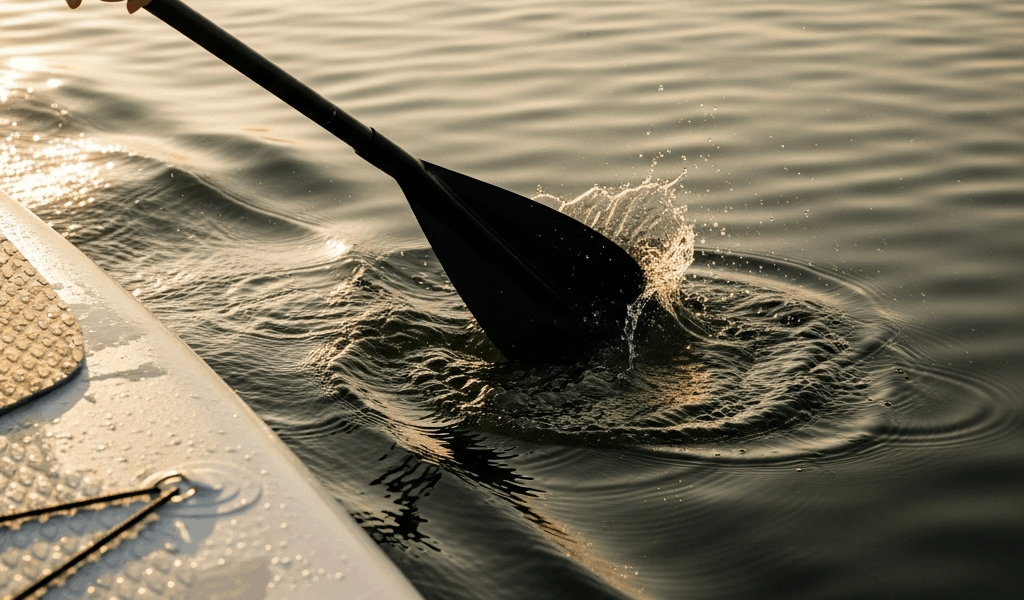
Why Most Beginners Paddle Wrong From the Start
Paddleboarding technique has gotten complicated with all the conflicting advice flying around. So let me tell you what actually happened to me instead.
My first three sessions on a paddleboard were genuinely embarrassing. I was getting outpaced by a guy on one of those inflatable flamingo pool floats — not joking — while my shoulders burned and my board zigzagged like it was actively avoiding the direction I wanted to go. I blamed the board. I blamed the wind. I blamed some vague “balance issue” I’d apparently developed.
Wasn’t any of that. I was paddling like I was in a canoe, hauling the blade through water with pure arm and shoulder muscle. It felt powerful. Natural, even. So I figured I was doing it right.
I wasn’t. And most beginners make this exact mistake — not because they’re careless, but because arm-driven movement is what our bodies already know. Push with your arms. Keep your core completely still. Tire yourself out in about twelve minutes. This one habit will destroy your paddle board paddling technique for beginners faster than any other single thing.
The fallout is predictable. You zigzag constantly instead of tracking straight. Your arms and shoulders are torched before you’ve covered half a mile. Speed stays glacial because every stroke partially fights your own momentum. Not fun. Not sustainable.
The fix isn’t about getting stronger or younger. It’s about learning where power actually comes from — your core — and retraining your body to use it. Once that clicks, everything else sorts itself out surprisingly fast.
How to Hold Your Paddle the Right Way
Probably should have opened with this section, honestly. Before anything about movement matters, the paddle has to be in your hands correctly.
The most common setup mistake I see is blade angle — specifically, holding it backwards. Your blade has a slight concave curve. That curved side, the power face, needs to face backward as you stroke. Beginners flip this constantly. The board starts tracking poorly, speed drops, and nobody understands why until someone physically turns the paddle around for them. Check yours right now if you’re not sure.
Hand spacing comes next. Roughly shoulder-width apart, maybe a couple inches wider. This gives you real leverage without burning out your arms. Too narrow and the paddle feels like it’s steering you instead of the other way around. Too wide and you’re working harder than necessary for zero extra benefit.
Which hand sits on top? Honestly, it doesn’t matter much at the beginner stage. Pick whichever feels natural on the handle and keep it consistent through your session. The top hand controls paddle angle. The bottom hand is where most of the drive comes from.
Grip pressure — relaxed. Not loose, or you’ll launch it into the water on your first real stroke. Relaxed. I’m apparently a death-gripper by default, and strangling my Bending Branches paddle handle worked for me the way setting money on fire works as a heating strategy. All it did was exhaust my forearms before my core ever got involved. Don’t make my mistake.
The Stroke That Actually Moves You Straight
Paddle board paddling technique for beginners comes down to one principle: power from rotation, not from pulling.
Every stroke breaks into four phases. Reach, plant, pull, exit. Each one matters.
Reach is where you extend the paddle forward with your arm fairly straight while rotating your shoulders forward. Your torso does most of this work — not your arms. Shoulder rotation is where the entire system lives or dies. Get this wrong and everything downstream suffers.
Plant happens when the blade enters the water near your feet, or just slightly ahead of them. This timing is critical. Too far forward and you’re fighting your own forward momentum before the stroke even starts. Too far back and the most powerful part of the stroke is already gone. Right at your feet. That’s the zone.
Pull is where most beginners fall apart — including past me. The instinct is to haul the blade down and toward your body using arm strength. That feels like power. It isn’t. What you actually want is to rotate your core through the stroke while the paddle stays roughly fixed in the water. Your body moves past the blade, not the other way around. Top shoulder rotates back, bottom shoulder rotates forward, and the paddle just rides along. Completely backwards from what your arms want to do, but that’s exactly where the real force comes from.
Pull past your hip and you create drag that yanks you sideways. Stop at your hip and you get maximum straight-line drive with minimal turning force. This one adjustment alone eliminates most of the zigzagging.
Exit is when the blade leaves the water around hip height. Pull it straight up and back — clean, no twist, no drag. That stroke is done. Now you’re already setting up the reach for the other side.
How to Switch Sides Without Losing Speed or Direction
Switching sides is where beginner wobbliness really shows up. Not because switching is technically difficult, but because most people do it randomly or at completely the wrong moment.
Start with a consistent rhythm — four to six strokes per side, then switch. Not three. Not eight. Four to six. That range gives you enough time to build momentum and hold a straight line before switching introduces any wobble. After several hundred strokes, your body starts anticipating the switch automatically. Everything smooths out.
The switch itself should look like this: blade comes cleanly out of the water on one side, rotates 180 degrees at roughly chest height — not up over your head, not down by your waist — and plants on the other side in one continuous motion. Most beginners either pause awkwardly mid-rotation or spin the paddle too far, creating that lurching, out-of-control look that signals a newcomer from fifty yards away.
Smoothness comes from repetition, not strength. Give it a few sessions. The switch becomes automatic. Your board stops jolting sideways every time you change sides. That’s usually the moment people tell me the board finally feels like it’s responding to them rather than doing its own thing.
Three Drills That Fix Bad Habits Fast
Drills matter because they isolate the exact problem and train it out before it gets wired in permanently. While you won’t need a coach or any special gear for these, you will need a willingness to feel slightly awkward in public for a little while. Small price.
Blade angle drill: Take slow, exaggerated strokes and watch your blade from the side. Power face backward. If it’s facing forward, stop completely and reset. Run this for about ten minutes until correct angle stops requiring conscious thought. You’ll notice the board tracking noticeably straighter almost immediately.
Core rotation drill: Keep your arms mostly straight and let your torso generate all the movement. This feels strange and weak initially — it’s neither. Within about twenty strokes you’ll feel your obliques and lower back doing actual work. That’s the sensation you’re chasing. Do 100 strokes this way, then paddle normally. The difference is obvious. Your real power source just woke up.
Straight line drill: Pick a fixed point on shore — a dock post, a tree, anything stationary — and paddle directly at it for roughly 200 meters without drifting. Slow down if you need to. Speed doesn’t matter here. Accuracy does. Most people feel a genuine shift after just one focused session of this.
That’s what makes paddleboarding endearing to us beginners, honestly — the improvements come fast once you’re working on the right things. Water, board, willingness to look a little awkward for twenty minutes. That’s the entire equipment list.
Technique cannot compensate for unsafe conditions or faulty equipment; start with our paddle-board stability and safety checklist.


Stay in the loop
Get the latest paddleboard spots updates delivered to your inbox.