Why Your Leash Keeps Detaching
Paddle board leash problems have gotten complicated with all the conflicting advice flying around. And if you’ve already watched your board drift away mid-session — that slow, sickening float toward the horizon while you tread water — you know exactly why this matters.
I’ve been paddling for about eleven years now, and in that time I’ve gone through probably a dozen leashes across three different boards. I learned everything there is to know about leash failure the hard way. Today, I’ll share it all with you.
Three things cause most detachments: worn or salt-caked velcro on the ankle cuff, a corroded or failing D-ring on the board itself, or the wrong leash style for your conditions. Sometimes it’s all three working together against you. The diagnostic approach matters more than panic-buying a replacement. Throw money at the wrong problem and you’ll be back in the water watching your board drift away again in a month.
Check Your Ankle Cuff First
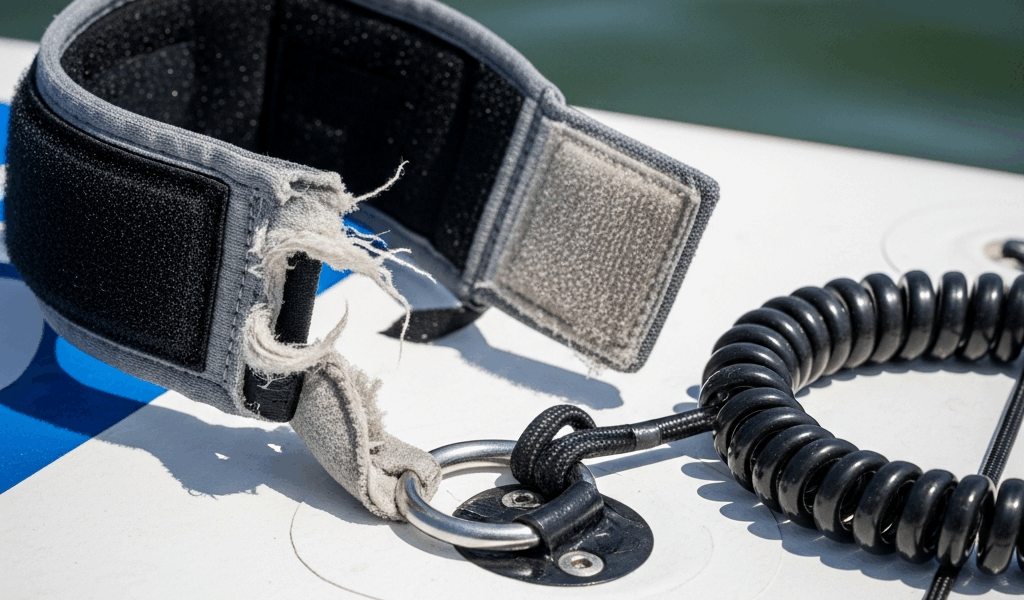
Startled by my leash slipping off during a flat-water session near Folly Beach, I hauled everything back to shore and inspected the cuff using nothing but my fingernail and bad lighting. The velcro looked completely fine from a normal standing distance. Up close? Disgusting.
Salt crystals had packed into the velcro pile like someone had dumped powdered sugar into the fibers. That’s the most common culprit — not actual velcro failure, but blockage that prevents the hook side from gripping anything. You can fix this in under five minutes with a toothbrush and a sink.
Run your finger across both velcro sides. The soft loop side should feel like velvet. The hook side should catch your skin slightly — almost uncomfortably so. Smooth and slick means salt buildup. Rinse the cuff under fresh water and scrub the hook velcro with an old toothbrush. Dry it completely before reattaching. Completely. A damp cuff re-collects salt faster.
Even after cleaning, press the cuff onto your forearm and try to pull it off. Real resistance is what you’re after — it should feel almost annoying to remove. If it peels away easily, the velcro pile is compressed from repeated use. Most cuff assemblies can’t be rehabilitated at that point. Replacements run about $12 to $25 depending on brand — FCS and Dakine both make solid ones that last considerably longer than the generic options.
Probably should have opened with this section, honestly. The wetsuit mistake alone has probably cost people hundreds of dollars in lost boards. Don’t wrap the cuff over a neoprene pant leg. The neoprene surface is too smooth. Velcro grips skin or tight fabric — not rubber. Wearing a 4/3 winter suit? Fold that pant leg down first, then secure the cuff directly to skin or the interior lining of the suit.
Test the tightness without a board attached. Two fingers between cuff and ankle — no more, no less. Too loose and it rotates throughout your session, working itself looser. Too tight and you’ll unconsciously loosen it on the water. That sweet spot is the foundation everything else depends on.
Inspect the D-Ring and Rail Mount
But what is a D-ring failure, exactly? In essence, it’s the board-side tether point giving up before the leash does. But it’s much more than that — it’s actually three distinct failure modes, and they require different responses.
The obvious one: corrosion. Hard fiberglass and epoxy boards typically use stainless steel D-rings. Salt water sitting in that assembly will eventually do its damage. White or green oxidation around the base means the ring has lost structural integrity — it becomes brittle. A brittle ring either snaps under load or simply pulls out of its mount. That’s what makes proper rinsing endearing to us hard-board enthusiasts. A 30-second freshwater rinse after every session buys you years of life on that hardware.
Soft-top boards use plastic D-rings glued into the deck. These are genuinely the weak link in the whole system. The adhesive fails before the ring does — I’m apparently unlucky with soft-tops and have had two Wavestorm-style budget boards fail at this exact point, while my friend’s Isle Versa has held up for four seasons without a single issue. Grab the D-ring and wiggle it firmly. Any movement at all means the glue is compromised. Budget boards frequently skip the reinforcing layer beneath the ring, leaving nothing but foam and adhesive holding everything together.
Don’t make my mistake — run your fingers around the stitching that holds the ring base to the rail before every few sessions, not just when something goes wrong. Fraying loops or visible gaps mean the attachment is degrading faster than you can see from the outside. On soft-tops, small cracks radiating from the ring base indicate foam separation from the surface deck.
Now test the swivel connector. Grab it and rotate it through a full circle. Smooth rotation with slight mechanical resistance is what you want. Stiff or grinding movement means salt is in the bearing. That binding creates stress points throughout the leash and gradually works the connector loose — you won’t notice until the board is 40 yards away.
When you clip into the D-ring, listen for a crisp click. That’s a properly seated connection. A soft thud or no resistance at all? The keeper ring is worn or the connector has micro-damage. Replace the connector — they’re about $6 to $10 at most paddle shops.
Match Your Leash Length and Style to the Conditions
You might have a perfectly functioning leash in completely the wrong application. That’s what makes leash selection endearing to us paddlers who’ve learned through embarrassing failures rather than research.
Coiled leashes work fine in flatwater. That’s genuinely their only home. In moving water — rivers, surf breaks, tidal channels — coiled leashes become a hazard. They uncoil suddenly and snap backward with real force. That snap can jerk the leash free from the D-ring or wrench your ankle. I saw this happen at a tidal cut near Pawleys Island. The paddler was fine. The board reached the next county.
Straight leashes hold consistently in moving water. Fewer connection points means less concentrated stress. A straight leash for an 8-foot board should run 8 to 9 feet end-to-end. Too short and you’re fighting resistance on every stroke. Too long and the excess creates slack that wraps around fins, obstacles, or other paddlers’ legs.
So, without further ado, the actual rule: leash length should match or slightly exceed board length. A leash significantly longer than your board invites failure — excess line snags fins and creates loops that weaken under tension. This new matching principle took off several years ago and eventually evolved into the standard that enthusiasts know and follow today.
Quick Fixes Before Your Next Session
While you won’t need a full gear overhaul, you will need a handful of basic supplies — a toothbrush, fresh water, and maybe $15 to $25 if the cuff needs replacing. First, you should run through this checklist before every launch — at least if you’d prefer your board stays attached to your body.
- Rinse the ankle cuff velcro under fresh water and scrub the hook side with a firm toothbrush. Dry it completely — hair dryer on low works well.
- Press the cuff to your forearm and peel it off. Real resistance means it’s functional. Easy peel means replace it before your next session.
- Grab the board-side D-ring and wiggle it firmly in every direction. Any movement at all is a problem worth solving on shore rather than on the water.
- Rotate the swivel connector through a full circle. Smooth is fine. Grinding means a fresh-water soak of at least one hour.
- Clip the leash into the D-ring and listen for the click. Tug it sharply three times with actual force — not a polite test tug.
- Wear the attached cuff on your ankle for 30 seconds on dry land. Apply the two-finger tightness test and adjust before you’re knee-deep in water.
If the swivel grinds, soak it in fresh water for an hour — sometimes two. If the cuff velcro makes no audible grip sound when pressed, retire that leash. A worn-out leash isn’t worth a lost board. A decent replacement — something like the Creatures of Leisure Icon leash — runs about $35 to $45. That’s considerably cheaper than recovering a $600 board, or not recovering it at all.

Stay in the loop
Get the latest paddleboard spots updates delivered to your inbox.