Why Your Board Drifts to One Side
Paddle boarding has gotten complicated with all the conflicting advice flying around. Everyone blames something different — your stroke, your board, your fins, the wind. I’ve been paddling for going on eleven years now, and I’ve coached maybe 200 beginners through this exact problem. Today, I will share it all with you.
But what is board drift, really? In essence, it’s your board consistently pulling left or right despite your best efforts to go straight. But it’s much more than that — it’s usually three separate problems wearing the same costume. Equipment issues like fin placement or a warped fin create mechanical pull. Paddle technique and body position either amplify or mask that pull. Wind and current account for the rest. Most paddlers I meet blame themselves when the real culprit is a loose fin screw. Others obsess over their stroke when they’re simply standing three inches off-center. So, without further ado, let’s dive in.
Check Your Fin First
Probably should have opened with this section, honestly. A loose or misaligned fin causes consistent one-directional drift more reliably than anything else — yet most paddlers immediately second-guess their stroke instead.
Pull the fin out and look at it. Cracks, warping, a bent trailing edge. A fin doesn’t need to be snapped clean off to pull your board sideways — even a 2-degree cant will create noticeable drift over a 50-foot stretch. Run your thumb along that trailing edge. Straight means fine. Any flex or sideways angle means that fin is your problem. Replace it. A decent replacement fin runs about $18–$35 on Amazon. Not worth paddling crooked for another season.
Next, check whether your fin is actually centered in the box. A loose fin sits slightly off to one side of the slot and creates constant lateral pressure. Push down hard on the fin while the board is on the ground — it should feel completely locked. Zero wobble. If it shifts at all, loosen the fin screw, reseat the fin firmly, and retighten. The base of the fin needs to sit flush against the bottom of the box. No gaps. No tilting.
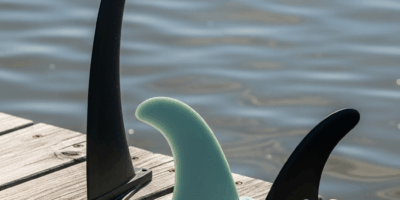
Running a three-fin setup? Your center fin is doing the tracking work. The side fins — sometimes called templetes on trimaran configurations — mostly affect turning radius and stability in choppy water. A loose center fin pulls the board in one direction with almost zero ambiguity. Check it first, every single time.
The 30-second on-water test
Before you paddle out, sit on your board in the water and push off gently with your paddle held flat. Does the nose track straight for ten feet, or does it immediately angle left or right? Straight means your fin placement is good. Immediate pull means your fin is bent or sitting off-center. Get out and fix it. Don’t make my mistake — I paddled an entire summer with a warped fin thinking I just had terrible form.
Fix Your Paddle Stroke
Your paddle technique accounts for more drift than any other single factor. As someone who spent two full years blaming my board for veering left constantly, I learned everything there is to know about this the hard way. Turns out I was catching water behind my hip and pulling harder on my right side without even noticing.
Here’s what actually happens. Most paddlers plant their blade too far behind their hip — sometimes three feet back instead of directly under their shoulder. That’s not a forward stroke anymore. That’s a rotation. Your torso does the work instead of your arms and core, and if one side catches deeper or drives harder, that rotation becomes a consistent turn.
The fix: plant your blade at your feet, not at your hip. Watch where the blade enters the water relative to your toes. It should enter almost directly under your shoulder as the stroke begins. This single adjustment fixes drift for roughly half the paddlers I’ve worked with. That’s it. Nothing else changed.
Then there’s uneven power. I’m apparently right-dominant — most people are — and my Starboard 10’5″ tracks fine now, but my old no-name board never corrected because I refused to believe my stroke was the issue. The stronger side wins every time, and your board tracks toward the weaker side. The 3-stroke rule fixes this. Switch sides every three strokes instead of every five or six. It feels completely awkward for about a week. Then it becomes automatic.
Blade angle is the last piece. If you’re rotating your grip hand inward — twisting your wrist as you pull — you’re torquing the blade into the water at an angle instead of driving it straight back. Keep your wrist neutral. Blade face perpendicular to the water at the catch. Twist from your core, not your arm.
Adjust Your Stance and Weight Distribution
Foot position and weight distribution determine whether your board points straight. Stand too far back and the nose lifts and wanders. Stand too far forward and the tail sinks and yaws. Stand off-center laterally — even six inches — and you’ve loaded one rail with enough pressure to create constant directional drift.
Find your balance point. Locate the carry handle on your board. That’s your center-balance reference point. Your feet should straddle it, shoulder-width apart, parallel to each other. Weight distributed evenly between both feet. That’s the default position — everything else is an adjustment from there.
Beginners unconsciously shift weight to their dominant foot. That foot loading tilts the rail, and the board follows. Awareness alone fixes this for most people. Film yourself paddling. I did this for the first time in year three and was genuinely shocked at how far right I was leaning. You’ll catch it immediately once you actually see it from outside your own body.
If you’ve centered yourself and the board still drifts, move one foot slightly forward or back to fine-tune. A half-foot adjustment forward sometimes compensates for wind pushing on the nose. But start from centered — always.
When Wind and Current Are the Real Culprit
Wind and current have gotten a bad reputation as excuses. But if your board tracks perfectly in flat, calm conditions and consistently veers sideways on open water, your environment is doing this — not your gear, not your form.
Wind pressure on the nose causes most of it. A light quartering wind pushes your bow offline. The board isn’t turning — it’s getting shoved. That’s what makes environmental drift so maddening to diagnose. The fix is angle, not power. Point your nose slightly into the wind before you launch. You’re not fighting it. You’re using the pressure to push you straight instead of sideways. Takes three or four attempts to dial in the exact angle. Launch slightly into the wind — if you’re drifting right, angle left a bit more. You’ll find the sweet spot fast.
Current works the same way. Read the water before you launch. Look for wind lines, ripple patterns, or foam streaks indicating current direction. Ten seconds of observation before you step on the board will tell you almost everything. Angle into the current like you would the wind. Most paddle spots have completely readable currents once you know what you’re looking at.
Quick reference — the two-question test
Does your board drift every single time you paddle, regardless of conditions? Start with your fin and your stroke. Does it only drift on open water? Check your stance and check the weather. That’s the whole diagnostic framework — two questions, three categories. That mental model alone saves most paddlers hours of frustrated troubleshooting on the water.

Stay in the loop
Get the latest paddleboard spots updates delivered to your inbox.