Why Your Paddle Board Feels So Heavy
Paddle board carrying has gotten complicated with all the bad advice flying around. As someone who bought a hard-shell board without a single thought about how I’d haul it from my truck to the waterline, I learned everything there is to know about this problem the hard way. Today, I will share it all with you.
That first board was a 24-pound, 10-foot epoxy — a Thurso Surf Expedition, if you’re curious. Doesn’t sound bad on paper. Felt like a refrigerator door by the time I’d stumbled 300 feet across a gravel parking lot, arms fully extended, sweating before I’d even touched the water.
But what is a “heavy” paddle board, really? In essence, it’s any board that costs you more energy getting to the water than actually paddling it. But it’s much more than that — because half the time, the weight printed on the spec sheet isn’t even the real culprit.
Three things tend to gang up on you at once.
First: genuine mass. Hard boards run 20 to 35 pounds depending on length and construction material. Inflatables sit between 15 and 28 pounds — but here’s what nobody mentions. Roll one up, stuff it in its bag, and you’ve got a cylinder that absolutely refuses to cooperate against your body. You grip harder trying to stabilize it. Your arms quit before you’ve cleared the parking lot.
Second: geometry. A 10-foot board is roughly as long as you are tall. Even a 20-pound board distributed across 120 inches behaves like something much heavier. You’re not carrying 20 pounds. You’re managing 20 pounds that’s actively trying to rotate, tip, and pivot in three directions simultaneously.
Third — and probably should have opened with this section, honestly — most people grab from the wrong spot entirely. That center carry handle on your board? Largely decorative in terms of actual balance. People grip it like a suitcase handle and immediately feel the weight shift toward one rail. Shoulder tightens. Wrist torques. Walk 200 feet like that and you’d swear the thing weighs 40 pounds.
Fix Your Carry Technique First
Before you buy anything or trade in your board, fix the carry. This one change alone drops perceived weight by 30 to 40 percent — no gear required.
The single-arm carry works for anything under 22 pounds. Slide one arm under the center of the board’s length — right where your armpit meets the rail — palm facing up. Your forearm becomes a shelf. Weight distributes across the whole arm instead of hanging from a clenched fist. Shoulder stays neutral. Grip stays loose. That’s what makes this method endearing to us recreational paddlers who aren’t exactly hauling gear for a living.
For longer hauls or heavier boards, try the over-the-head carry. Hoist the board up and rest it across both shoulders, center handle sitting just behind your neck. Gravity does the holding. Hands hang free. I’ve walked 500 feet this way without real fatigue — though fair warning, you will look like you’re doing some sort of interpretive fitness routine in the parking lot.
Two-person carry is the obvious move for anything over 28 pounds. One person on each rail near the midpoint. A 30-pound board becomes 15 pounds each. Done. This is how the serious paddlers I’ve watched at busy beach launches actually handle their gear — efficiently, without drama.
The mistake I see constantly: someone grabs the tail handle and tries to muscle the board up against their shoulder vertically. That’s how fins get snapped and forearms get destroyed. Don’t make my mistake — the balance point is always at the center, full stop.
Gear That Makes Carrying Way Easier
So, without further ado, let’s dive into the actual gear worth considering — once your technique is already solid.
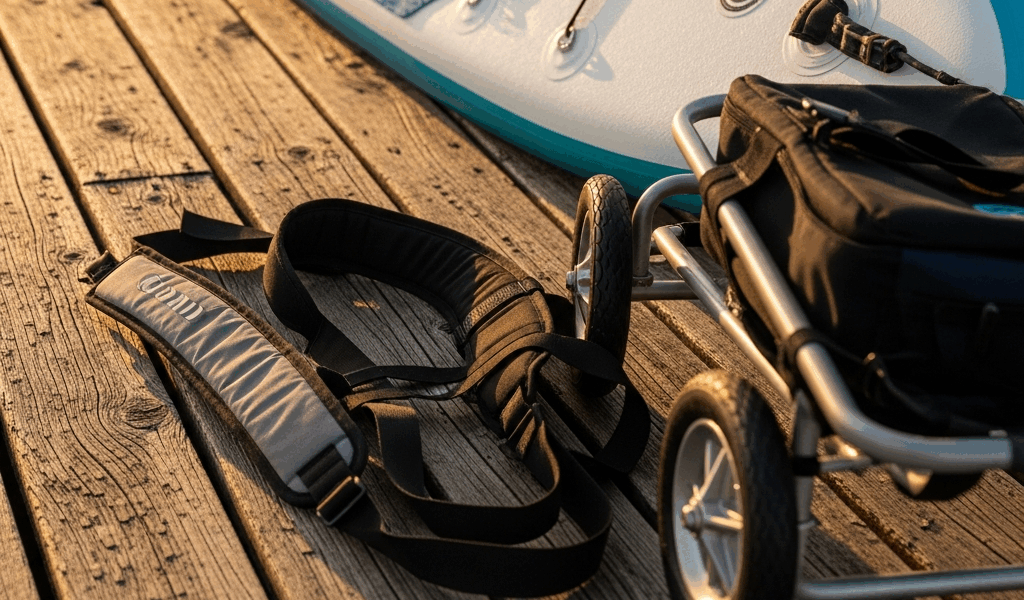
While you won’t need anything elaborate, you will need a handful of straightforward tools to make regular transport genuinely painless. A paddle board carry strap is the simplest entry point. It’s a padded sling — wraps across your chest, clips to your board’s carry points, and turns the whole thing into a messenger bag situation. Weight shifts to your torso — your strongest load-bearing structure — instead of grinding through your grip strength. Quality straps from brands like BoardStrap or Shoulder-a-Board run $25 to $50. Adjustable padding, works for any board type. I’m apparently a narrow-shouldered person and the BoardStrap model works for me while the knockoff version I tried first never sat right.
A wheeled board cart might be the best option, as hard board transport requires rolling rather than lifting whenever the terrain allows. That is because pavement and smooth launches are everywhere — and strapping a 35-pound board to an aluminum cart with pneumatic tires means you’re rolling it, not carrying it. Rubbish Rack and BoardLok both make solid models in the $60 to $120 range. Catch: add 10 to 15 pounds for the cart itself, and forget it on soft sand.
Padded handle wraps are a micro-fix worth mentioning. Skinny plastic factory handles wreck your hand on longer carries. Wrap it with neoprene or foam padding — $10 to $20, five minutes of work. Doesn’t solve everything, but a 10-minute carry feels noticeably different with a thicker grip.
For inflatable boards specifically, invest in a reinforced carry bag with padded shoulder straps. Don’t just roll the board naked and bear-hug it to the water. A proper bag distributes pressure across the bundle and gives you actual handles. Figure $30 to $60. Inflatable boards are already the travel-friendly choice — might as well finish the job.
When the Board Itself Is the Problem
Sometimes the real issue is a mismatch — wrong board, wrong body, wrong fitness baseline. That’s just the honest answer.
Most paddlers handle boards under 25 pounds solo for up to half a mile without much trouble. Recreational flat-water hard boards push 26 to 32 pounds. Thick epoxy construction or longer touring shapes hit 30 to 38 pounds. Possible to carry — but it demands consistent grip strength and dialed-in technique every single time.
Smaller paddlers, beginners, anyone managing shoulder or wrist issues — a board over 28 pounds creates real friction with the hobby. You spend more energy on the 400-foot walk than on an hour of paddling. That’s a legitimate reason to reconsider your setup, not a weakness.
An inflatable board makes sense in this situation. Typically 16 to 24 pounds, forgiving on technique, and they travel in a backpack. Slightly less responsive on the water than a hard board — that’s the real trade-off — but if the carry was stopping you from going at all, the inflatable wins by default.
Carbon construction hard boards are the opposite direction. If you’ve nailed the technique, you’re paddling regularly, and you want to shed real weight from your setup, carbon saves 5 to 10 pounds over epoxy equivalents. You’re looking at $1,200 to $2,500 versus $400 to $800. That was a tough number for me to type. But for someone paddling three or four times a week, that weight difference genuinely changes how often you decide to go.
Getting It to the Water Without Wrecking Your Back
Consolidate this into an actual routine before your next session. Here’s how that looks in practice.
- Park as close to the launch as possible. A 100-foot walk versus a 500-foot walk sounds minor — it isn’t, repeated across a whole season.
- Use a wheeled cart on pavement or any flat, firm surface. Carrying is only for the terrain where wheels won’t go.
- Recruit a partner for anything over 30 pounds. Two people and it’s genuinely effortless.
- For carries under five minutes, balance the board on your hip. Don’t overthink it.
- Solo and going more than a few hundred feet? Over-the-head carry is the most efficient option, biomechanically speaking.
- Paddling regularly and moving your board more than a quarter mile each trip? A $40 carry strap pays for itself in about three sessions.
A heavy paddle board is a logistics problem. That’s it. Fix the grip first, layer in gear where it makes sense for your specific situation, and honestly assess whether the board you own actually matches your body and your fitness level right now. Most people crack this without spending a dime — just by shifting where they hold the board and letting their body find the balance point. Once it clicks, carrying becomes automatic. You stop thinking about it entirely and just go paddle.

Stay in the loop
Get the latest paddleboard spots updates delivered to your inbox.