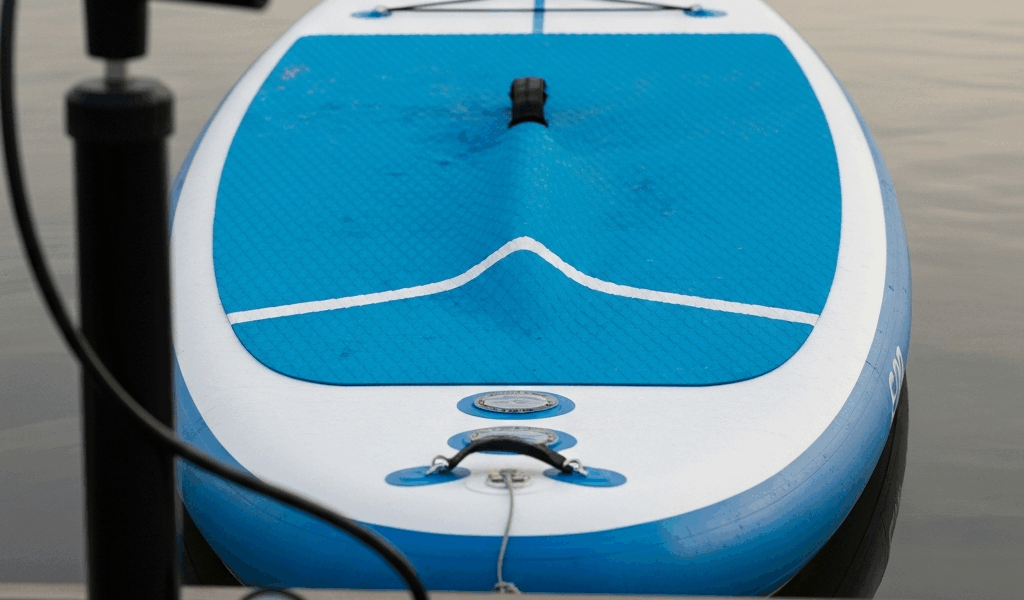
Why Your Board Sinks in the Middle
Paddleboarding has gotten complicated with all the conflicting advice flying around. And nothing kills your enthusiasm faster than stepping onto your board and watching the middle slowly swallow your feet. I’ve been there — soaked, frustrated, genuinely considering posting the thing on Facebook Marketplace for whatever someone would offer.
As someone who has owned four different boards over eight years, I learned everything there is to know about this specific problem. Today, I will share it all with you.
The short version: it’s almost always fixable. Usually it comes down to one of three things, and only the last one might actually cost you money.
First possibility — your board isn’t inflated to the right PSI. This alone accounts for the majority of sinking-middle complaints. A soft inflatable flexes like a trampoline underfoot. Second possibility — your board’s volume is too low for your body weight. Boards have limits, and riding past them is immediately noticeable. Third possibility — your stance is off. Standing too far forward, too far back, or with your feet pinched together throws weight distribution completely sideways.
So, without further ado, let’s dive in.
Step 1 — Check and Fix Your PSI First
Probably should have opened with this section, honestly. It fixes the problem about nine times out of ten.
Grab a pressure gauge — automotive, digital, analog, doesn’t matter. They run $8 to $15 at any hardware store. The one I use cost me $11 at Home Depot. Nothing fancy required.
Most recreational inflatables call for somewhere between 12 and 15 PSI. Check your board’s manual or look for the sticker on the board itself. Some performance-oriented boards push up to 18 PSI, but if you’re newer to paddleboarding, start at the lower end of your board’s recommended range. More forgiving that way.
Here’s the thing about hand pumps: they lie to you. They get hard to push toward the end, so your brain says you’re done. You’re probably not. A typical hand pump maxes out around 8 to 10 PSI before the effort becomes genuinely brutal — and 10 PSI on a board rated for 14 is noticeably mushy. I’m apparently someone who convinced himself he was “close enough” for two entire seasons, and my old Insta-Inflate hand pump never actually got me where I needed to be. Don’t make my mistake.
An electric pump with an auto-shutoff costs $30 to $60 and removes the guesswork entirely. I switched to a Bravo Super-High Pressure model and now my 10’6″ board is properly inflated in under five minutes. Set it, walk away, done.
A correctly inflated board feels firm underfoot — not rock-hard, but with maybe a quarter-inch of give when you press your thumb hard into the surface. Under-inflated boards feel squishy. You’ll see actual dimpling and flex just from standing there.
Check your PSI before every single session. Boards bleed air over time, especially sitting in summer heat. A board at 10 PSI when it should be at 14 will sink in the middle and feel unstable at the rails.
Still sinking after you hit the correct number? Move on.
Step 2 — Match Your Weight to Board Volume
But what is board volume? In essence, it’s the measurement — in liters — of how much water a board displaces, which determines how much weight it can support. But it’s much more than a single spec on a product page. It’s the difference between riding on the water and riding in it.
Typical recreational boards land somewhere between 120 and 200 liters. Touring boards go higher. Racing boards run lower. The number directly controls how high you sit in the water and how stable the board feels under your feet.
Here’s a simple calculation worth writing down: multiply your body weight in pounds by 1.1 to get your bare minimum volume in liters. Multiply by 1.4 if you want something genuinely comfortable and stable.
A 200-pound paddler needs at least 220 liters — at absolute minimum. For a relaxed, forgiving ride, that same person should be looking at 280 liters. Not suggestions. Math.
If your board falls below your calculated minimum, no amount of PSI adjustment fixes the problem. The board simply isn’t displacing enough water for your weight. That’s it. That’s the whole issue.
I made this mistake once with a 10′ × 30″ board rated at 135 liters. At 185 pounds, I was technically within the stated weight limit — barely. Flat calm water felt fine. The moment any chop came in, the board felt like it was folding underneath me. I upgraded to a 180-liter board and the difference was genuinely night-and-day. That was 2019, and I haven’t had a volume problem since.
Board specs are usually printed directly on the board, on the original box, or buried somewhere on the manufacturer’s website. Find yours. If it’s undersized for your weight, that’s your answer. If it meets or beats your calculated number, keep going.
Step 3 — Adjust Your Stance on the Board
Weight distribution matters more than most beginners expect. That’s what makes stance so endearing to us paddlers — it’s completely free to fix and works immediately.
Find the carry handle running across the middle of your board. That’s your center point. Your feet should straddle it, roughly shoulder-width apart. Toes forward. Knees slightly bent. That’s it.
Standing too far back presses the tail down and raises the nose — and weirdly, the unweighted middle flexes more under the strain of that imbalance. Standing too far forward does the same thing in reverse. Both feel like the board is collapsing underneath you. Neither is actually a board problem.
Feet too close together also amplifies the problem. A wider stance spreads your weight across more of the board’s surface area, which dramatically reduces the dip-and-bounce sensation that feels so unsettling when you’re new.
Try this: stand fully centered, feet shoulder-width, for one complete lap around a calm section of water. Then deliberately shift your feet back a few inches. Feel the difference? The middle drops noticeably — same board, same PSI, just a few inches of movement. That’s how much stance actually matters.
When the Board Itself Is the Problem
While you won’t need to be an expert repair technician, you will need a handful of basic supplies and about twenty minutes. First, you should rule out a slow leak — at least if your board starts a session firm and sinks progressively during use.
Mix dish soap with water in a spray bottle. Spray every seam, every inch of the board surface, and especially around the valve. Watch for bubbles. Bubbles mean escaping air. Mark any spot you find with a permanent marker so you don’t lose it.
Frustrated by a mysterious slow leak on my older board, I spent a full afternoon doing exactly this test using a $2 bottle of Dawn and a spray bottle from the dollar store. Found a pinhole near the fin box I never would have spotted otherwise. Fixed it the same afternoon.
A loose valve cap causes more leaks than people realize. Tighten the cap counterclockwise and retest before assuming anything worse.
Vinyl repair kits might be the best option for punctures and small seam failures, as this type of repair requires a clean, dry surface and a little patience. That is because adhesive bonds poorly to damp or dirty material — rush it and you’ll be redoing the job inside a week. Most kits run $10 to $20, and if you weight the patch down for a full 24 hours, the fix usually holds.
If your board still can’t hold pressure for a 30-minute session after all of that, replace it. Internal delamination isn’t reliably fixable, and a board that slowly goes soft mid-session is a genuine safety issue.
Run the diagnosis in order. PSI first. Volume second. Stance third. Board integrity last. Most of the time you won’t make it past Step 1.


Stay in the loop
Get the latest paddleboard spots updates delivered to your inbox.