Why Your Fin Setup Actually Matters
Paddle boarding has gotten complicated with all the gear chatter flying around. Everyone’s debating board shapes and paddle materials — meanwhile, the thing that actually controls how your board behaves in the water gets maybe thirty seconds of attention at the shop counter. That’s backwards.
As someone who spent three full summers blaming my own paddling for problems that had nothing to do with technique, I learned everything there is to know about fin setups the hard way. My board veered left constantly. I’d paddle harder on the right, overcorrect, veer right, overcorrect again. My forearms were wrecked by the end of every session. I swapped out my thruster for a single center fin — a $34 FCS unit, nothing fancy — and the board locked into a line like it was on rails. That was session four of summer three. Don’t make my mistake.
Today, I will share it all with you.
Your fin configuration decides whether you track dead straight or arc all over the place. It affects stability in choppy water. It determines how much energy you burn fighting your own equipment instead of actually paddling. Most people never touch this variable. They buy a new board or sign up for lessons when the real fix costs thirty bucks and takes four minutes to install.
The two complaints I hear constantly? “My board won’t go straight” and “I can’t get it to turn when I want to.” Both are fin problems wearing different masks. Both are fixable today.
Single Fin vs Thruster vs 2+1 — What Each Does
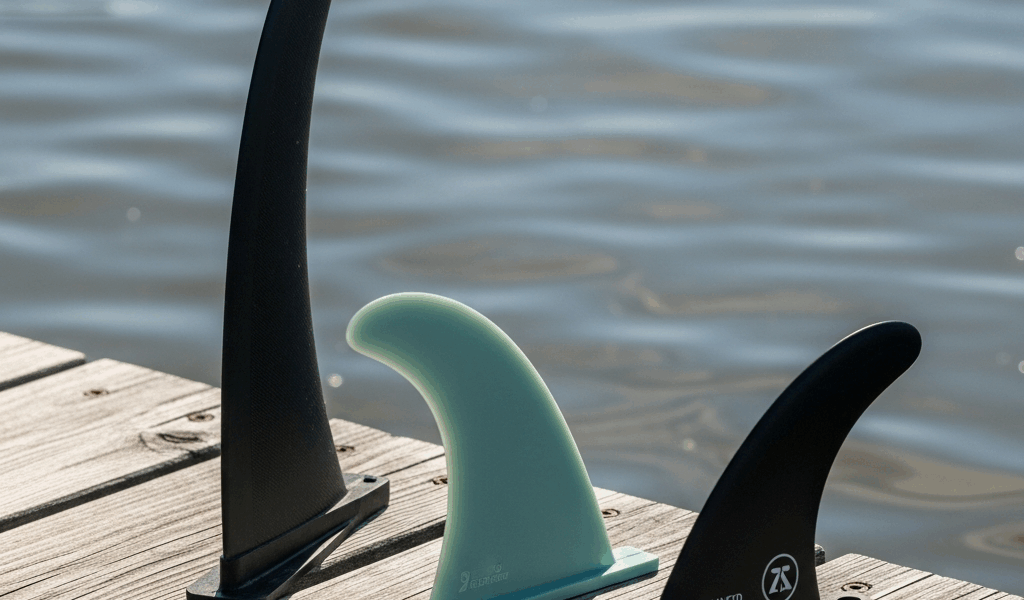
But what is a fin setup, really? In essence, it’s the combination of fins under your board that controls how water flows beneath you. But it’s much more than that — it’s the single biggest behavioral variable on any paddle board, and swapping configurations changes the feel of a session more dramatically than almost any other adjustment.
Single fin setups create a deep tracking channel. The board wants to go straight and largely does. For long-distance touring on flat water, this is efficiency in hardware form.
Thrusters run three smaller fins — two side fins, one center. They prioritize quick direction changes over straight-line hold. Surfers love them because waves demand sharp pivots and fast releases off the tail. On flat water, though? Thrusters feel twitchy. Jittery. You’re constantly making micro-corrections that add up to a lot of wasted energy over a few miles.
The 2+1 system splits the difference. A larger center fin handles tracking. Two smaller side fins positioned forward add lateral stability and maneuverability. It holds a line better than a thruster, turns more easily than a pure single. Honestly, if you’re new to this and not sure what you want, 2+1 is the safest starting point — it doesn’t force you into a corner either way. That’s what makes the 2+1 endearing to us touring paddlers who occasionally want to mess around in light surf without re-rigging everything.
So, without further ado, let’s dive in.
How to Match Your Fin Setup to Your Paddling Style
Your ideal setup depends entirely on where you actually paddle. Not where you want to paddle. Where you actually go.
Flat Water Touring — Single Fin or 2+1
Covering distance on lakes or calm rivers? Single fin. Full stop. Zero wasted energy fighting lateral drift. A center fin in the 8–10 inch range — depending on your board length — keeps you locked in and moving forward. The 2+1 works here too if you want slightly more maneuverability without giving up much tracking. I’m apparently a creature of habit and the single fin works for me while the thruster never did on open water.
SUP Yoga and Fitness — 2+1 or Thruster
You’re not covering ground. You’re holding positions, moving deliberately, maybe doing slow laps. What you need is stability at rest and the ability to reposition without paddling sideways across the lake. A 2+1 delivers lateral support through those side fins while keeping the board manageable. A thruster works if your board runs short — under ten feet — and you want that locked-in, surrounded feeling from all sides.
Ocean Surfing — Thruster
Waves move. Your board needs to respond fast. Thrusters are non-negotiable here — the side fins release tail pressure through turns, the center fin provides drive. This is literally what the design was built for. Using a single fin in surf is like wearing hiking boots to run a 5K. Technically possible. Genuinely miserable.
Whitewater Rivers — Single Fin
Probably should have opened with this section, honestly. Current is your main challenge in moving water, and a single center fin handles it cleanest — predictable tracking, simple setup, nothing to snag on rocks mid-rapid. Keep it simple. Keep it safe.
Common Fin Problems and How to Fix Them
Fin Keeps Popping Out
Your locking mechanism is worn or it wasn’t installed correctly the first time. Most modern boards use a push-pin or click-in system — the pin slides through a groove on the fin base and locks perpendicular to the slot. If it feels loose, check for a small set screw along the fin box edge. A standard Phillips head tightens it. Two minutes, done. If the pin won’t grip at all or the fin base itself is cracked, you need a replacement. Don’t ignore a loose fin mid-session — it falls out, you’re swimming after it, and your session is over.
Board Won’t Track Straight Even With a Fin
Three things to check before you do anything else. First, is the fin centered in the box? A misaligned fin causes constant drift regardless of paddling technique. Second, is the fin sized correctly for your board? An undersized fin simply won’t generate enough hold. Third — and this one gets overlooked — is your weight centered on the board? Leaning even slightly forward or back changes how the fin sits in the water column. If all three check out and you’re still drifting, your center fin is probably too flexible or too small. A 9–10 inch fin handles most 10–11 foot boards well. Adjust roughly half an inch per foot of board length from there.
Fin Makes Rattling Noise
Trapped air or a loose screw — almost always one of those two. Pull the fin out completely. Check that the locking pin is fully engaged when you reinsert it. Clear the fin box slot of any sand or debris first — a grain of sand in the wrong spot causes more rattling than you’d expect. If the noise continues after a clean reinstall, a small strip of foam tape on the fin base where it contacts the board dampens the vibration without touching performance. That fix costs nothing if you have tape in the garage.
What to Do If Your Board Only Has One Fin Box
You’re not stuck. A quality center fin does roughly 90% of the work in any fin system. The remaining 10% — the side fins — add stability and response at the edges. For touring, fitness paddling, or distance work, that 10% is largely irrelevant.
Size by board length: 8 inches for boards under 10 feet, 9 inches for 10–11 footers, 10 inches or more for anything longer. The half-inch differences sound trivial. They’re not. A fin that’s too small feels squirmy and loses its edge under any real load. A fin that’s too large creates drag and makes turning genuinely exhausting — like paddling with a small anchor.
Shape matters, but less than size. Flexible fins — fiberglass or plastic construction — absorb wave impact and forgive beginner weight shifts. Stiff fins — carbon or rigid composite — respond faster and reward experienced paddlers who know how to use that response. FCS and Futures both make solid center fins in the $25–60 range. Nothing exotic required.
First, you should use whatever fin came with your board — at least if it’s still intact and the right size for your length. If you’re buying a first replacement, stay within the manufacturer’s recommended size range. A properly fitted single fin on flat water will outperform a thruster setup nearly every time. The hardware doesn’t need to be complicated. It just needs to fit.


Stay in the loop
Get the latest paddleboard spots updates delivered to your inbox.