Why Paddle Boards Spin Instead of Track Straight
Paddle boarding has gotten complicated with all the conflicting advice flying around. As someone who has spent years working rental docks and teaching group lessons, I learned everything there is to know about why boards spin. Today, I will share it all with you.
Your board keeps rotating. Your arms are burning. Your ego is taking a hit. And the person paddling right beside you is cutting a laser-straight line while you’re doing what can only be described as a slow-motion pirouette in open water.
Here’s the thing — it’s fixable. Almost always without buying anything new. What you actually need is a diagnosis, not a new board.
I’ve watched this exact scenario play out hundreds of times. Rental docks, beginner lessons, group paddles on Saturday mornings. The spinning problem traces back to one of four things: fin setup, paddle technique, stance position, or the environment itself. Each one has a specific fix. So, without further ado, let’s dive in.
Your Fin Is the First Thing to Check
Probably should have opened with this section, honestly. The fin is where roughly 70% of tracking problems actually live.
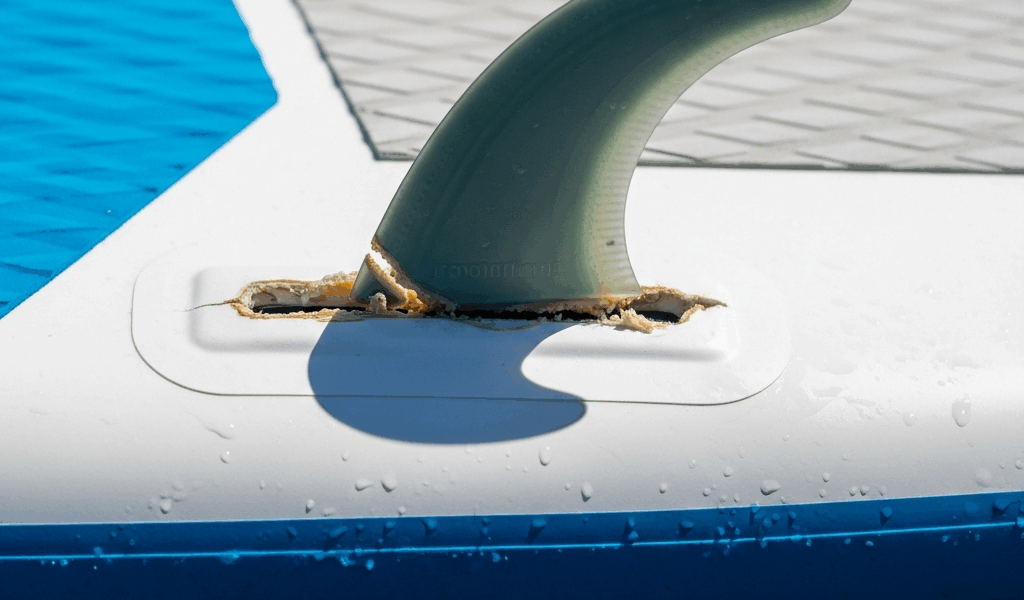
Start with the obvious. Is the fin there? I am completely serious. Lost fins happen more than anyone admits. Flip the board, check the fin box. Empty box — that’s your whole answer right there.
Now assume it’s installed. Pull it out anyway. Look at how it seats. A correctly mounted fin sits flush — no gaps, no side-to-side wobble. If you can wiggle it with two fingers, it isn’t tight enough. Grab a tool and torque that screw down properly. Your fingers are not a tool.
Position within the box matters more than most people realize. Too far forward and the pivot point shifts toward the nose — the tail swings wide behind you on every stroke. Too far back and the nose swings out instead. Most standard SUP fins perform best somewhere near the middle of the box, nudged maybe a half-inch toward the rear. That’s it. That small.
If everything looks secure, measure the fin depth. I’m apparently particular about this, and a 7- to 8-inch fin works for me while anything under 7 inches never really cuts it beyond mirror-flat water. Anything less than 7 inches is essentially rental-grade hardware — fine for a calm lagoon, useless the moment any chop or crosswind shows up. Don’t make my mistake of ignoring this for two full seasons.
Get back on the water. Paddle a straight line — or try to — for 20 strokes without correcting. Still drifting? Move on. Tracking clean? You just solved it.
Your Paddle Stroke Is Probably Pulling You Off Course
But what is a correct paddle stroke? In essence, it’s a clean vertical pull through a specific zone alongside the board. But it’s much more than that.
The single most common mistake I see: the paddle entry and exit are both happening behind the paddler’s hip. When that happens, you’re pulling water sideways as much as you’re pulling it backward. The board doesn’t go straight. It pivots. Every. Single. Stroke.
Good technique looks like this. Picture a zone running from your front knee down to your ankle while you’re standing in normal position. Your blade should enter the water at the front of that zone — that’s your catch. Your exit should come around hip level. Not past it. At it. This keeps the stroke aligned with the board’s centerline and stops the rotational pull almost immediately.
Catching yourself pulling past your hip? Shorten the reach. Consciously plant the blade forward before you pull. It feels wrong the first dozen times — like you’re not reaching far enough. You are. Trust the geometry.
The second error is crossing the centerline on your switch side. You paddle left, switch to right, but the right stroke angles across your body toward the left rail. That cross-body pull rotates the board just as reliably as a bad fin. Fix it by keeping shoulders square and letting your torso rotate — not your arms. The paddle stays in front of your midline the entire stroke.
Zigzagging? That’s overcorrection. You felt the board drift left, hammered hard on the right, now it’s drifting right. Switch sides every 4 to 6 strokes instead of 8 to 10, and make your corrections gentle — not power moves. That’s what makes consistent paddling endearing to us SUP enthusiasts rather than exhausting.
Where You Stand on the Board Changes Everything
Stance position shifts how the board sits in the water. Frustrated by constant spinning despite fixing everything else, many paddlers never think to look down at their feet — yet that’s exactly where the problem hides.
Stand too far back and the tail sinks, the nose lifts clear of the water. That high nose catches wind and turns the board like a weathervane. You can have perfect technique and a properly sized fin and still spin constantly because your weight is just a few inches too far stern.
Too far forward and the nose buries — different problem, same result. Resistance pulls the board sideways and you lose any meaningful control.
The sweet spot: feet centered roughly over the board’s midpoint, maybe slightly behind it. Most boards have a center carry handle molded into the deck. Use that as your landmark — your feet should straddle it, weight directly over it, not a foot behind it.
Here’s a 30-second test. Stand in your normal position right now. Look down. Where are your feet relative to that handle? Behind it — move forward. Way in front — back up an inch or two. Paddle 10 strokes. The board should feel noticeably more neutral. Less fighting. Less spinning.
Crosswind conditions demand a wider stance — somewhere around 18 to 20 inches between feet. A narrow stance in any real wind makes every correction stroke feel unstable, like you’re balancing on a tightrope while someone blows a leaf blower at your chest.
Wind and Current Are Working Against You — Here Is How to Adapt
Everything above assumes reasonably calm water. Wind and current rewrite the rules entirely.
Crosswind conditions produce drift even when your technique is dialed and your stance is perfect. The board weathervanes — tail swings downwind, nose points into it. You can’t overpower physics, but you can stop fighting it and start working with it instead.
Angle the board slightly into the wind. Not a dramatic turn — maybe 10 to 15 degrees off your intended heading. The wind still pushes, but the board’s angle resists it. You end up tracking reasonably straight rather than constantly correcting a board that’s actively trying to turn around.
Switch sides more frequently in wind. Four strokes per side instead of six. Frequent switches let you make small, controlled corrections rather than dramatic lurching power strokes that overcorrect the other direction.
Current behaves differently. Paddling upstream actually improves tracking — water resistance increases and holds the board steadier. Downstream current pushes the board sideways, same principle as crosswind. Angle into it. Same fix.
While you won’t need perfect conditions every time you paddle, you will need a handful of honest adjustments to your expectations. Some days are just hard. Choppy water, 15-mph crosswind, current pushing against you — you will not go perfectly straight. Accept that. Make controlled corrections and stop chasing perfection. That’s what separates paddlers who enjoy themselves from paddlers who come home frustrated every single time.

Stay in the loop
Get the latest paddleboard spots updates delivered to your inbox.